Question
If $\begin{vmatrix}\text{a}&\text{b}-\text{y}&\text{c}-\text{z}\\\text{a}-\text{x}&\text{b}&\text{c}-\text{z}\\\text{a}-\text{x}&\text{b}-\text{y}&\text{c}\end{vmatrix}=0,$ then using properties of determinants, find the value of $\frac{\text{a}}{\text{x}}+\frac{\text{b}}{\text{y}}+\frac{\text{c}}{\text{z}},$ where $\text{x},\text{y},\text{z}\neq0.$
Answer

$\Rightarrow\begin{vmatrix}\text{a}&\text{b}-\text{y}&\text{c}-\text{z}\\\text{a}-\text{x}&\text{b}&\text{c}-\text{z}\\\text{a}-\text{x}&\text{b}-\text{y}&\text{c}\end{vmatrix}=0$
$R_1 → R_1 - R_2$
$\Rightarrow\begin{vmatrix}\text{x}&-\text{y}&0\\\text{a}-\text{x}&\text{b}&\text{c}-\text{z}\\\text{a}-\text{x}&\text{b}-\text{y}&\text{c}\end{vmatrix}=0$
$R_2→ R_2 - R_3$​​​​​​​
$\Rightarrow\begin{vmatrix}\text{x}&-\text{y}&0\\0&\text{y}&-\text{z}\\\text{a}-\text{x}&\text{b}-\text{y}&\text{c}\end{vmatrix}=0$
Expanding along first row, we get
$\text{x}(\text{yc}+\text{zb}-\text{zy})+\text{y}(0-\text{za}+\text{zx})=0$
$\Rightarrow\text{xyc}+\text{xzb}-2\text{xyz}+\text{zya}=0$
Dividing by $xyz$, we get
$\frac{\text{c}}{\text{z}}+\frac{\text{b}}{\text{y}}-2+\frac{\text{a}}{\text{x}}=0$
$\therefore\frac{\text{a}}{\text{x}}+\frac{\text{b}}{\text{y}}+\frac{\text{c}}{\text{z}}=2$

Need a full question paper?

Generate a complete, print-ready paper with questions like this in minutes — across 16+ boards, with answer keys.

Start Generating Free

Similar questions

Find the approximate change in the surface area of a cube of side $x$ metres caused by decreasing the side by $1\%.$
verify that $\text{y}=\text{ce}^{\tan^{-1}}$ is a solution of the differential equation $(1+\text{x}^2)\frac{\text{d}^2\text{y}}{\text{dx}^2}+(2\text{x}-1)\frac{\text{dy}}{\text{dx}}=0.$
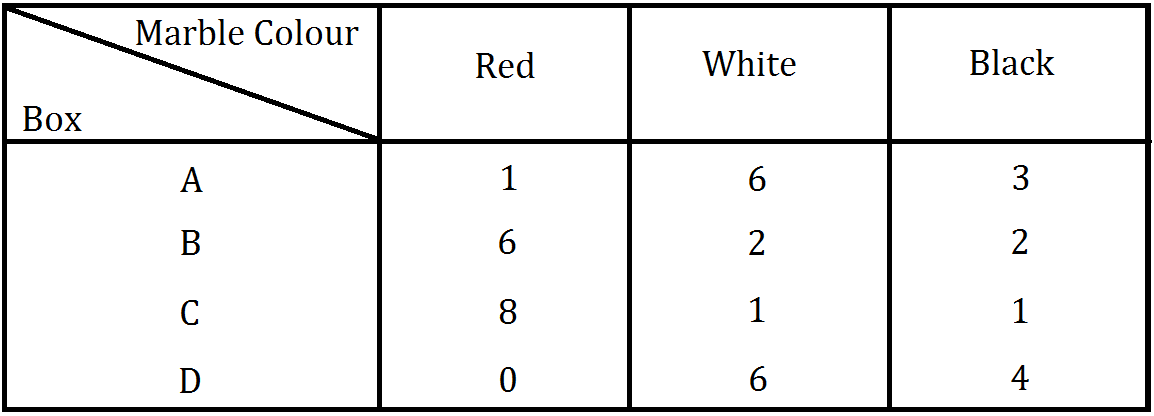
Suppose we have four boxes A, B, C, D containing coloured marbles as given below:
One of the boxes has been selected at random and a single marble is drawn from it. If the marble is red, what is the probability that it was drawn from,
  1. Box A?
  2. Box B?
  3. Box C?
Vitamins $A$ and $B$ are found in two different foods $F_1$ and $F_2$. One unit of food $F_1$ contains $2$ units of vitamin $A$ and 3 units of vitamin $B$. One unit of food $F_2$ contains $4$ units of vitamin $A$ and 2 units of vitamin $B$. One unit of food $F_1$ and $F_2$ cost Rs $50$ and $25$ respectively. The minimum daily requirements for a person of vitamin $A$ and $B$ is $40$ and $50$ units respectively. Assuming that anything in excess of daily minimum requirement of vitamin $A$ and $B$ is not harmful, find out the optimum mixture of food $F _1$ and $F _2$ at the minimum cost which meets the daily minimum requirement of vitamin $A$ and $B$. Formulate this as a LPP.
An isosceles triangle of vertical angle 2θ is inscribed in a circle of radius a. Show that the area of the triangle is maximum when $\theta = \frac{\pi}{6}.$
Solve the following differential equation:
$\cos^2(\text{x}-2\text{y}) = 1-2\frac{\text{dy}}{\text{dx}}$
Find the points of discontinuity, if any of the following function:
$\text{f(x)}=\begin{cases}2\text{x},&\text{ if}\text{ x}<0\\0,&\text{if }0\leq\text{x}\leq1\\4\text{x},&\text{if }\text{ x}>1\end{cases}$
Verify Rolle's theorem of the following function on the indicated interval
$\text{f}(\text{x})=\text{e}^{\text{x}}\cos{\text{x}}\text{ on }\Big[\frac{-\pi}{2},\frac{\pi}{2}\Big]$
Using elementary transformation, find the inverse of each of the matrices, $\begin{bmatrix}2& 0&-1 \\5 & 1&0\\0&1&3 \end{bmatrix}$
Find the vector equation of the plane passing through points $3\hat{\text{i}}+4\hat{\text{j}}+2\hat{\text{k}},2\hat{\text{i}}-2\hat{\text{j}}-\hat{\text{k}}$ and $7\hat{\text{i}}+6\hat{\text{k}}.$