MCQ
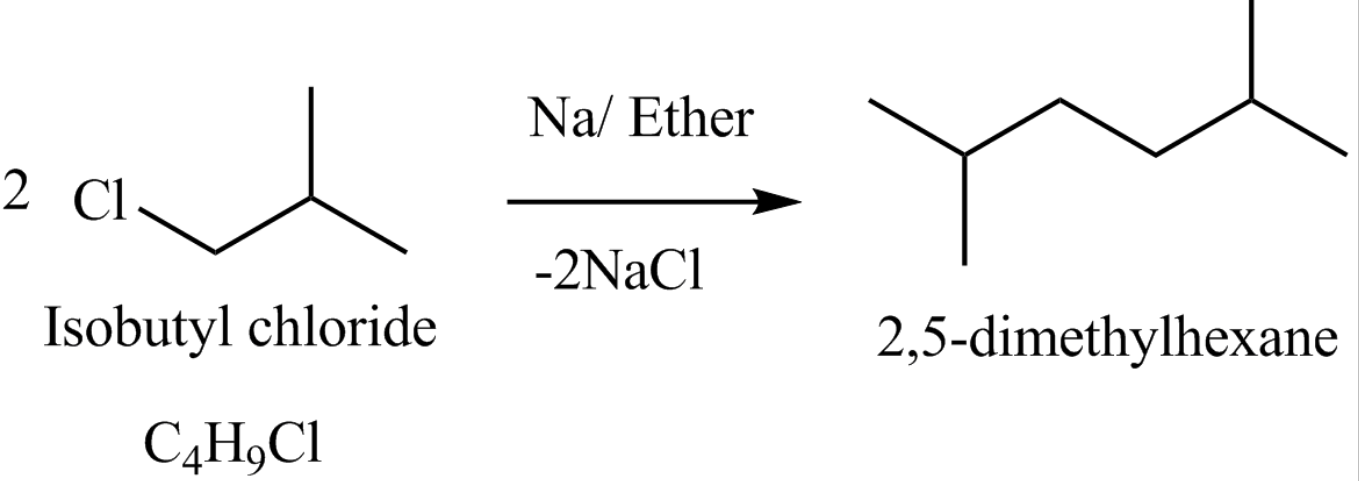
If C4​H9​Cl with Na/ether gives 2,5-dimethylhexane, then the compound, C4​H9​Cl is:
  • A
    n-butylchloride
  • B
    sec-butylchloride
  • C
    iso-butylchloride
  • D
    tert-butylchloride

Answer

  1. iso-butylchloride

Explanation:

The reaction of Isobutyl chloride (C4​H9​Cl) with Na/Ether gives 2,5-dimethylhexane. This is a condensation reaction in which two molecules of sodium chloride are obtained for every molecule of 2,5-dimethylhexane.
Need a full question paper?

Generate a complete, print-ready paper with questions like this in minutes — across 16+ boards, with answer keys.

Start Generating Free

Similar questions

Given below are two statements : one is labelled as Assertion $A$ and the other is labelled as Reason $R$ :

Assertion $A$ : Aryl halides cannot be prepared by replacement of hydroxyl group of phenol by halogen atom.

Reason $R$ : Phenols react with halogen acids violently. In the light of the above statements, choose the most appropriate from the options given below:
An electric current is passed through silver nitrate solution using silver electrodes. $10.79 \,g$  of silver was found to be deposited on the cathode if the same amount of electricity is passed through copper sulphate solution using copper electrodes, the weight of copper deposited on the cathode is ............. $\mathrm{g}$
Acetyl bromide reacts with excess of $C{H_3}MgI$ followed by treatment with a saturated solution of $N{H_4}Cl$ gives
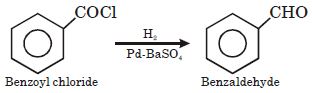
In the following reaction, product $P$ is $R - \mathop {\mathop {C - }\limits^{||\,\,\,\,} }\limits^{O\,\,\,} Cl$  $\mathop {\xrightarrow{{{H_2}}}}\limits_{Pd - BaS{O_4}} P$
Ammonia gas can be collected by the displacement of
Which one of the following statements is correct when $SO_2$ is passed through acidified $K_2Cr_2O_7$ solution?
The electrons which take part in order to exhibit variable oxidation states by transition metals are
Liquid $‘M’$ and liquid $‘N’$ form an ideal solution. The vapour pressures of pure liquids $‘M’$ and $‘N’$ are $450$ and $700\,mmHg,$ respectively at the same temperature. Then correct statement is:
( $x_M =$ mole fraction of $‘M’$ in solution; $x_N =$ mole fraction of $‘N’$ in solution;
$y_M =$ mole fraction of $‘M’$ in vapour phase; $y_N =$ mole fraction of $‘M’$ in vapour phase)
For a chemical reaction $A \to B$ it is found that the rate of reaction doubles, when the concentration of $A$ is increased four times. The order in $A$  for this reaction is
The above reaction is know as :-