Question
If cathode rays are projected at right angles to a magnetic field, their trajectory is (a) Ellipse(b) Circle(c) Parabola(d) None of these
       

Answer

(b) Circle

Need a full question paper?

Generate a complete, print-ready paper with questions like this in minutes — across 16+ boards, with answer keys.

Start Generating Free

Similar questions

Resistance of the metal increases with temperature because:
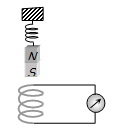
A magnet $NS$ is suspended from a spring and while it oscillates, the magnet moves in and out of the coil $C.$ The coil is connected to a galvanometer $G.$ Then as the magnet oscillates,
If n drops, each of capacitance $C,$ coalesce to form a single big drop, then the ratio of the energy stored in the big drop to that in each small drop will be
Which one of the following is similar between electrostatic force and gravitational force?
Assertion $: A$ current $I$ flows along the length of an infinitely long straight and thin walled pipe. Then the magnetic field at any point inside the pipe is zero.
Reason $: \oint \overrightarrow{\mathrm{B}} \cdot \mathrm{d} \overrightarrow{\mathrm{l}}=\mu_0 \mathrm{I}$
An electron oscillating with a frequency of $3 \times 10^6 Hz,$ would generate:
C and Si both have the same lattice structure, having 4 bonding electrons in each. However, C is an insulator whereas Si is an intrinsic semiconductor. This is because
A. In case of C the valence band is not completely filled at absolute zero temperature.
B. In case of C the conduction band is partly filled even at absolute zero temperature.
C. The four bonding electrons in the case of C lie in the second orbit, whereas in the case of Si they lie in the third.
D. The four bonding electrons in the case of C lie in the third orbit, whereas for Si they lie in the fourth orbit.
The period of oscillation of a magnet in vibration magnetometer is 2 sec. The period of oscillation of a magnet whose magnetic moment is four times that of the first magnet is(a) 1 sec(b) 4 sec(c) 8 sec  (d) 0.5 sec
       
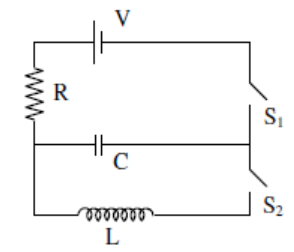
In an $\text{LCR}$ circuit as shown below both switches are open initially. Now switch $S_1$​ is closed, $S_2$​ kept open. $(q$ is charge on the capacitor and $\tau=\text{RC}$ is capacitive time constant$).$ Which of the following statement is correct?
Image
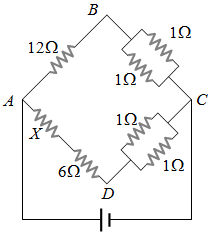
For what value of unknown resistance $X,$ the potential difference between $B$ and $D$ will be zero in the circuit shown in the figure