MCQ
If $\cos(\alpha+\beta)=0$ then $\sin(\alpha-\beta)=?$
  • A
    $\sin\alpha$
  • B
    $\cos\beta$
  • C
    $\sin2\alpha$
  • $\cos2\beta$

Answer

Correct option: D.
$\cos2\beta$
$\cos(\alpha+\beta)=0$
$\Rightarrow\cos(\alpha+\beta)=\cos90^\circ$
$\Rightarrow\alpha+\beta=90^\circ$
$\Rightarrow\alpha=90^\circ-\beta$
Now, $\sin(\alpha-\beta)=\sin(90^\circ-\beta-\beta)$
$=\sin(90^\circ-2\beta)$
$=\cos2\beta$

Need a full question paper?

Generate a complete, print-ready paper with questions like this in minutes — across 16+ boards, with answer keys.

Start Generating Free

Similar questions

A number when divided by $143$ leaves $31$ as remainder. What will be the remainder when the same number is divided by $13?$
If $D_x=-18$ and $D=3$ are values of determinant for certain simultaneous equation in $x$ and $y$ then value of $x$ is _______.
Mark the correct alternative in the following:
The first three terms of an $A.P.$ respectively are $3y - 1, 3y + 5$ and $5y + 1$. Then, $y$ equals:
If $4x + 6y = 3xy$ and $8x + 9y = 5xy$ then:
Each question consists of two statements, namely, Assertion $(A)$ and Reason $(R).$ For selecting the correct answer: use the following code:
Assertion $(A)$ Reason $(R)$
If the median and mode of a frequency distribution are $150$ and $154$ respectively, then its mean is $148.$ Mean, median and mode of a frequency distribution are related as: mode $= 3$ median $- 2$ mean
The mean of a discrete frequency distribution $x_if_i$ ; $i= 1, 2, ……, n$ is given by:
Consider the following distribution:
Class $0-5$ $5-10$ $10-15$ $15-20$ $20-25$
Frequency $10$ $15$ $12$ $20$ $9$
The sum of the lower limits of the median class and the modal class is:
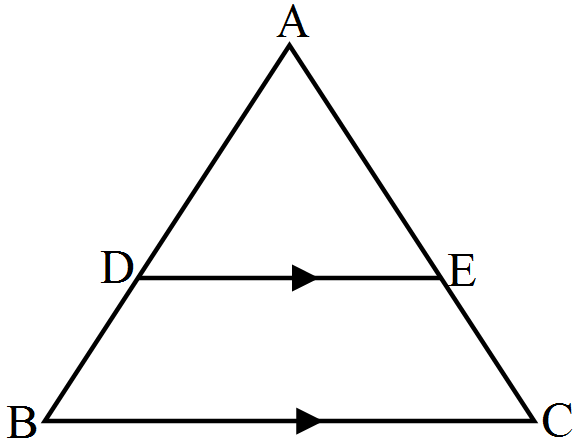
In $\triangle\text{ABC},\text{DE }\|\text{ BC}$ so that $AD = (7x - 4)cm, AE = (5x - 2)cm, DB = (3x + 4)cm$ and $EC = 3x \ cm.$ Then, we have:
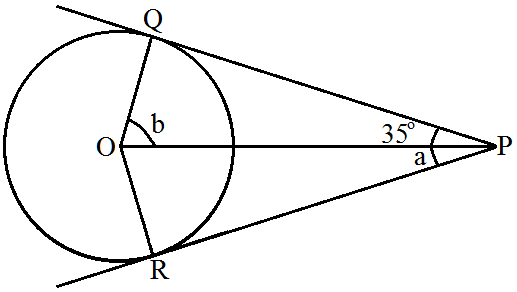
In the given figure, $\text{PQ}$ and $\text{PR}$ are tangents drawn from $P$ to a circle with centre $O$. If $\angle\text{OPQ}=35^\circ$, then:
The abscissa of the point of intersection of the Less Than Type and of the More Than Type cumulative frequency curves of a grouped data gives its: