Question
If $\cos\theta=\frac{12}{13},$ show that $\sin\theta(1-\tan\theta)=\frac{35}{156}.$
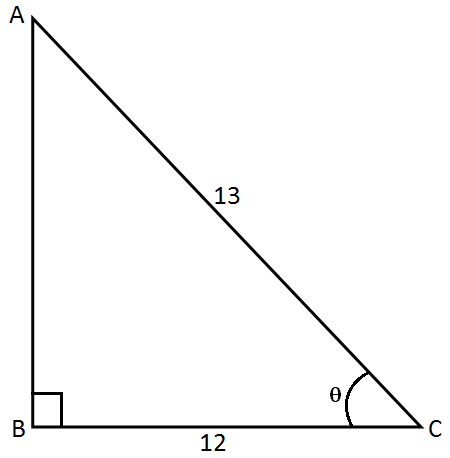
Answer

Given: $\cos\theta=\frac{12}{13}\ \dots(1)$
To show that $\sin\theta(1-\tan\theta)=\frac{35}{156}$
Now, we know that $\cos\theta=\frac{\text{Base side adjacent to}\angle\theta}{\text{Hypotenuse}}\ \dots(2)$
Therefore, by comparing equation (1) and (2) We get, Base side adjacent to $\angle\theta=12$ And Hypotenuse = 13

Therefore from above figure Base side $BC = 12$
Hypotenuse $AC = 13$
Side AB is unknown and it can be determined by using Pythagoras theorem
Therefore by applying Pythagoras theorem
We get, $AC^2= AB^2 + BC^2$
Therefore by substituting the values of known sides
​​​​​​​We get, $13^2 = AB^2 + 12^2​​​​​​​$​​​​​​​
Therefore, $\text{AB}^2=169-144$ $\text{AB}^2=25$
$\text{AB}=\sqrt{25}$ Therefore, $\text{AB}=5\ \dots(3)$
Now, we know that $\sin\theta=\frac{\text{Perpendicular side opposite to}\angle\theta}{\text{Hypotenuse}}$
Now from figure (a) We get, $\sin\theta=\frac{\text{AB}}{\text{AC}}$
Therefore, $\sin\theta=\frac{5}{13}\ \dots(4)$
Now, we know that $\tan\theta=\frac{\text{Perpendicular side opposite to}\angle\theta}{\text{Base side adjacent to }\angle\theta}$
Now from figure (a) We get, $\tan\theta=\frac{\text{AB}}{\text{BC}}$
Therefore, $\tan\theta=\frac{5}{12}\ \dots(5)$
Now L.H.S. of the equation to be proved is as follows
$\text{L.H.S.}=\sin\theta(1-\tan\theta)\ \dots(6)$
Substituting the value of $\sin\theta$ and $\tan\theta$ from equation (4) and (5) respectively We get,
$\text{L.H.S.}=\frac{5}{13}\Big(1-\frac{5}{12}\Big)$
Taking L.C.M inside the bracket We get, $\text{L.H.S.}=\frac{5}{13}\Big(\frac{1\times12}{1\times12}-\frac{5}{12}\Big)$
Therefore, $\text{L.H.S.}=\frac{5}{13}\Big(\frac{12-5}{12}\Big)$
$\text{L.H.S.}=\frac{5}{13}\Big(\frac{7}{12}\Big)$
Now, by opening the bracket and simplifying We get,
$\text{L.H.S.}=\frac{5\times7}{13\times12}$
$\text{L.H.S.}=\frac{35}{156}\ \dots(7)$ From equation (6) and (7), it can be shown that
$\sin\theta(1-\tan\theta)=\frac{35}{156}$

Need a full question paper?

Generate a complete, print-ready paper with questions like this in minutes — across 16+ boards, with answer keys.

Start Generating Free

Similar questions

The following table gives the distribution of the life time of $400$ neon lamps:
Lite time $($in hours$)$ Number of lamps
$1500-2000$ $14$
$2000-2500$ $56$
$2500-3000$ $60$
$3000-3500$ $86$
$3500-4000$ $74$
$4000-4500$ $62$
$4500-5000$ $48$
Find the median life time of a lamp.
Find the roots of the following quadratic equations by the factorisation method:
$21\text{x}^2-2\text{x}+\frac{1}{21}=0.$
Verify that $5,-2$ and $\frac{1}{3}$ are the zeros of the cubic polynomial $p(x)=3 x^3-10 x^2-27 x+10$ and verify the relation between its zeros and coefficients.
Solve the following quadratic equation:
$\frac{\text{x}-4}{\text{x}-5}+\frac{\text{x}-6}{\text{x}-7}=3\frac{1}{3},$ $\text{x}\neq5,7$
An age$-$wise list of number of literate people in a block is prepared in the following table. There are total $100$ people and their median age is $41.5$ years. Information about two groups are missing, which are denoted by $x$ and $y.$ Find the value of $x$ and $y.$
Age $($in years$)$ Number of literate people
$10-20$ $15$
$20-30$ $X$
$30-40$ $12$
$40-50$ $20$
$50-60$ $Y$
$60-70$ $8$
$70-80$ $10$
From the following data, draw the two types of cumulative frequency curves and determine the median:
Height (in cm)
Frequency
140-144
3
144-148
9
148-152
24
152-156
31
156-160
42
160-164
64
164-168
75
168-172
82
172-176
86
176-180
34
The interior of a building is in the form of a right circular cylinder of diameter 4.2m and height 4m surmounted by a cone of same diameter. The height of the cone is 2.8m. Find the outer surface area of the building.
If $\tan\text{A}=\text{n}\tan\text{B}$ and $\sin\text{A}=\text{m}\sin\text{B},$ prove that $\cos^2\text{A}=\frac{\big(\text{m}^2-1\big)}{\text{n}^2-1}.$
Find the area of a right-angled triangle, the radius of whose circumcircle measure 8cm and the altitude drawn to the hypotenuse measures 6cm.
Let there be an $A.P.$ with first term $'a\ ',$ common difference $'d\ '.$ If $a_n$ denotes its $n^{\text {th }}$ term and $S_n$ the sum of first $n$ terms, find. $n$ and $S _{ n } ,$ if $a =5, d=3$ and $a _{ n }=50.$