Question
If $\cot\theta=\frac{3}{4},$ prove that $\sqrt{\frac{\sec\theta-\text{cosec }\theta}{\sec\theta+\text{cosec }\theta}}=\frac{1}{\sqrt{7}}.$
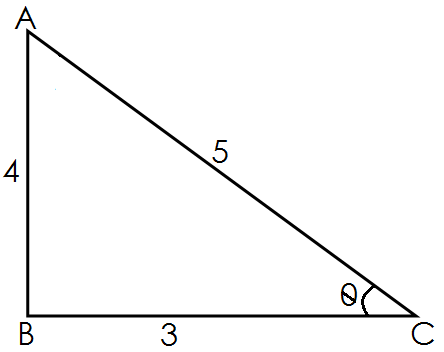
Answer


Given,
$\cos\theta=\frac{3}{4}$
base = 3, perpendicular = 4
by P.G.T.
$\text{h}=\sqrt{\text{P}^2+\text{b}^2}=\sqrt{4^2+3^2}$
$=\sqrt{16+9}=\sqrt{25}=5$
$\sec\theta=\frac{\text{h}}{\text{b}}=\frac{5}{3},\text{cosec}\theta=\frac{\text{h}}{\text{P}}=\frac{5}{4}$
Taking L.H.S. $\sqrt{\frac{\sec\theta-\text{cosec}\theta}{\sec+\text{cosec}\theta}}=\sqrt{\frac{\frac{5}{3}-\frac{5}{4}}{\frac{5}{3}+\frac{5}{4}}}$
$=\sqrt{\frac{\frac{20-15}{12}}{\frac{20+15}{12}}}=\sqrt{\frac{5}{35}}=\sqrt{\frac{1}{7}}\ =\text{R.H.S}$

Need a full question paper?

Generate a complete, print-ready paper with questions like this in minutes — across 16+ boards, with answer keys.

Start Generating Free

Similar questions

If a circle touches the side $BC$ of a triangle $ABC$ at $P$ and extended sides $A B$ and $A C$ at $Q$ and $R$, respectively, prove that $AQ =\frac{1}{2}( BC + CA + AB )$
Find the sum of the first 15 terms of each of the following sequences having $n^{th}$​​​​​​​ term as
$a_n = 3 + 4n$
The. number of telephone calls received at an exchange per interval for $250$ successive one-minute intervals are given in the following frequency table:
No of calls (x)
$0$
$1$
$2$
$3$
$4$
$5$
$6$
No of intervals (f)
$15$
$24$
$29$
$46$
$54$
$43$
$39$
Compute the mean number of calls per interval.
If $\text{cosec }\theta=\frac{13}{12},$ find the value of $\frac{2\sin\theta-3\cos\theta}{4\sin\theta-9\cos\theta}$.
Find two consecutive odd positive integers, sum of whose squares is $970$.
Find the value(s) of k for which the points (3k - 1, k - 2), (k, k - 7) and (k - 1, -k - 2) are collinear.
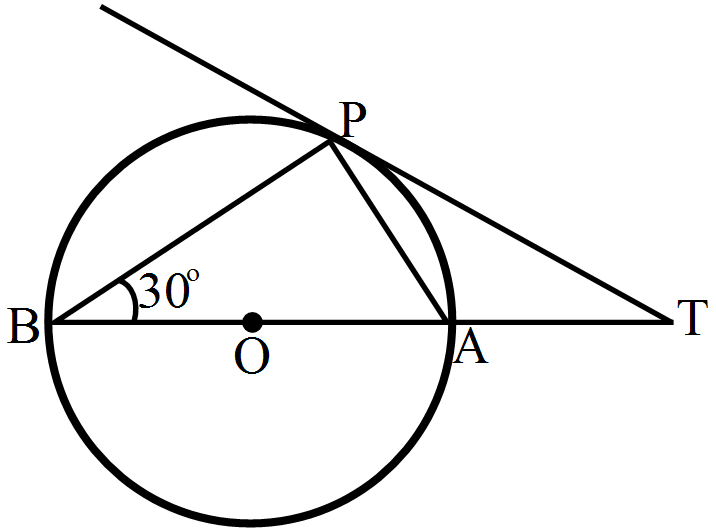
In the given figure, O is the centre of the circle and TP is the tangent to the circle from an external point T. If $\angle\text{PBT} = 30^\circ,$prove that
BA : AT = 2 : 1.
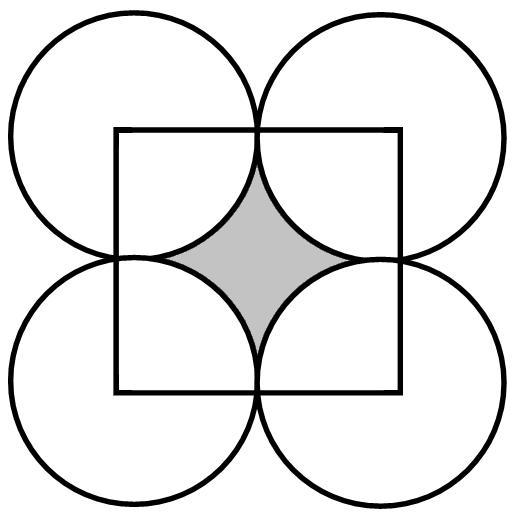
The diameter of a coin is $1\ cm$ (in the following figure). If four such coins be placed on a table so that the rim of each touches that of the other two, find the area of the shaded region $\big(\text{Take }\pi = 3.1416\big). $
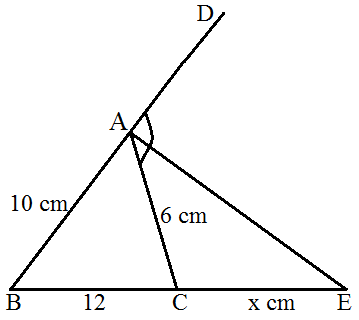
In fig. AE is the bisector of the exterior $\angle\text{CAD}$ meeting BC produced in E. If AB = 10cm, AC = 6cm and BC = 12cm, find CE.
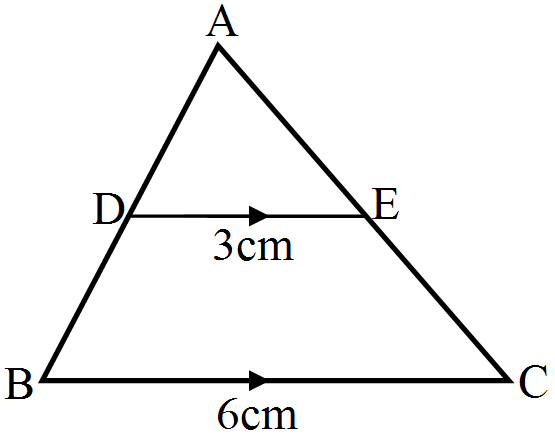
In the given figure, DE || BC. If DE = 3cm, BC = 6cm and $\text{ar}(\triangle\text{ADE})=15\text{cm}^2,$ find the area of $\triangle\text{ABC}.$