MCQ
If $\Delta = \left| {\,\begin{array}{*{20}{c}}{{a_1}}&{{b_1}}&{{c_1}}\\{{a_2}}&{{b_2}}&{{c_2}}\\{{a_3}}&{{b_3}}&{{c_3}}\end{array}\,} \right|$ and ${A_1},{B_1},{C_1}$denote the co-factors of ${a_1},{b_1},{c_1}$ respectively, then the value of the determinant $\left| {\begin{array}{*{20}{c}}{{A_1}}&{{B_1}}&{{C_1}}\\{{A_2}}&{{B_2}}&{{C_2}}\\{{A_3}}&{{B_3}}&{{C_3}}\end{array}} \right|$ is
  • A
    $\Delta $
  • ${\Delta ^2}$
  • C
    ${\Delta ^3}$
  • D
    $0$

Answer

Correct option: B.
${\Delta ^2}$
b
(b) We know that $\Delta \,\Delta ' = \left| {\,\begin{array}{*{20}{c}}{{a_1}}&{{b_1}}&{{c_1}}\\{{a_2}}&{{b_2}}&{{c_2}}\\{{a_3}}&{{b_3}}&{{c_3}}\end{array}\,} \right|.\left| {\,\begin{array}{*{20}{c}}{{A_1}}&{{B_1}}&{{C_1}}\\{{A_2}}&{{B_2}}&{{C_2}}\\{{A_3}}&{{B_3}}&{{C_3}}\end{array}\,} \right|$

$ = \left| {\,\begin{array}{*{20}{c}}{\Sigma {a_1}{A_1}}&0&0\\0&{\Sigma {a_2}{A_2}}&0\\0&0&{\Sigma {a_3}{A_3}}\end{array}\,} \right| = \left| {\,\begin{array}{*{20}{c}}\Delta &0&0\\0&\Delta &0\\0&0&\Delta \end{array}\,} \right| = {\Delta ^3}$

==> $\Delta ' = {\Delta ^2}$.

Need a full question paper?

Generate a complete, print-ready paper with questions like this in minutes — across 16+ boards, with answer keys.

Start Generating Free

Similar questions

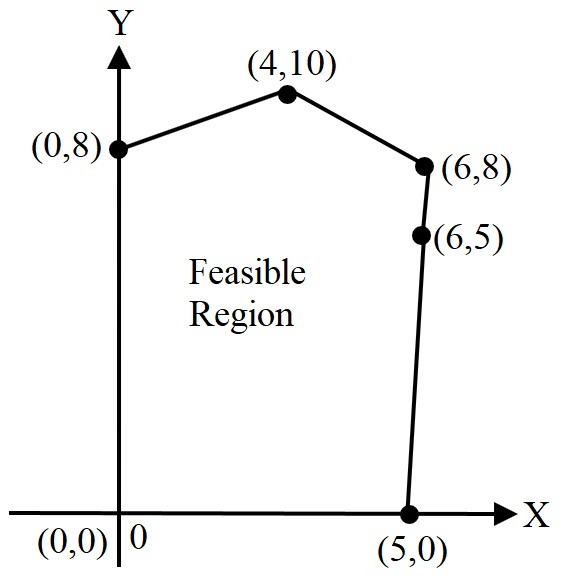
The feasible, region for an LPP is shown shaded in the figure. Let Z = 3x - 4y be the objective function. A minimum of Z occurs at:

If the system of equations $x + 2y + 3z = 4 , x + py + 2z = 3 , x + 4y + \mu z = 3$ has an infinite number of solutions , then :
Let $f(x) = \int {\frac{{{x^2}dx}}{{(1 + {x^2})\,\left( {1 + \sqrt {1 + {x^2}} } \right)}}} $and $f(0) = 0$, then the value of $f(1)$ be
$a$  and  $ b$  are two non-collinear vectors, then $xa + yb$ (where  $x$ and $y$  are scalars) represents a vector which is
If A and B are two events such that $\text{P(A)}=\frac{4}{5},$ and $\text{P}(\text{A}\cap\text{B})=\frac{7}{10},$ then P(B|A) =
  1. $\frac{1}{10}$
  2. $\frac{1}{8}$
  3. $\frac{7}{8}$
  4. $\frac{17}{20}$
Integrating factor of the differntial equation $\cos\text{x}\frac{\text{dy}}{\text{dx}}+\text{y}\sin\text{x}=1$is:  
  1. $\sin\text{x}$
  2. $\sec\text{x}$
  3. $\tan\text{x}$
  4. $\cos\text{x}$ 
The equation of a line passing through the point $(-3, 2, -4)$ and equally inclined to the axes, are
If $\text{f(x)}=\begin{cases}\text{ax}^2+\text{b},&0\leq\text{x}<1\\4,&\text{x}=1\\\text{x}+3,&1<\text{x}\leq2\end{cases}$ then the value of (a, b) for which f(x) cannot be continuous at x = 1, is:
  1. (2, 2)
  2. (3, 1)
  3. (4, 0)
  4. (5, 2)
If X is a random variable with probability distribution as given below:

X = xi 0 1 2 3
P(X = Xi) k 3k 3k k

The value of k and its variance are:

Write the direction cosines of a line parallel to the line $\frac{3-x}{3}=\frac{y+2}{-2}=\frac{z+2}{6}$.