Question
If $\frac{a}{c}=\frac{c}{d}=\frac{c}{f}$ prove that $: \frac{\left(a^3+c^3\right)^2}{\left(b^3+d^3\right)^2}=\frac{e^6}{f^6}$

Answer


$\begin{aligned} & \frac{a}{c}=\frac{c}{d}=\frac{c}{f}= k \text { (say) } \\ & \therefore a = bk , c = dk _{ r } e = fk \\ & \text { L.H.S. } \frac{\left(a^3+c^3\right)^2}{\left(b^3+d^3\right)^2} \\ & =\frac{\left(b^3 k^3+d^3 k^3\right)^2}{\left(b^3+d^3\right)^2} \\ & =\frac{\left[k^3\left(b^3+d^3\right)\right]^2}{\left(b^3+a^3\right)^2} \\ & =\frac{k^6\left(b^3+d^3\right)^2}{\left(b^3+d^3\right)^2}= k ^6 \\ & \text { R.H.S. }=\frac{e^6}{f^6} \\ & =f^6 \frac{k^6}{f^6}= k ^6 \\ & \therefore \text { L.H.S. }=\text { R.H.S. }\end{aligned}$

Need a full question paper?

Generate a complete, print-ready paper with questions like this in minutes — across 16+ boards, with answer keys.

Start Generating Free

Similar questions

Draw an ogive for the following data:
Marks0 - 1010 - 2020 - 3030 - 4040 - 5050 - 60
No. of students710235163
$\triangle ABC \sim \triangle  DEF.$ If $BC = 3cm , EF=4cm$ and area of $\triangle ABC = 54\ cm^2 ,$ find area of $\triangle DEF.$
The sum of first n terms of an A.P. whose first term is 8 and the common difference is 20 equal to the sum of first 2n terms of another A.P. whose first term is – 30 and the common difference is 8. Find n.
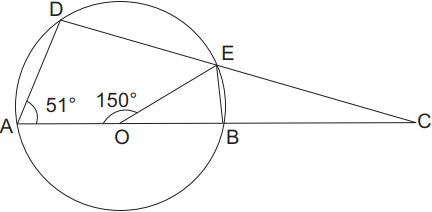
In the figure, $O$ is the centre of the circle.
$\angle \mathrm{AOE}=150^{\circ}, \angle \mathrm{DAO}=51^{\circ} .$
Calculate the measures of $\angle \mathrm{BEC}$ and $\angle \mathrm{EBC}$.
Image
Vivek invests Rs 4,500 in 8%, Rs 10 shares at Rs 5. He sells the shares when the price rises to Rs 30, and invests the proceeds in 12% Rs 100 shares at Rs 125. Calculate :
(1) the sale proceeds
(2) the number of Rs 125 shares he buys.
(3) the change in his annual income from the dividend.
Find the difference between the simple interest and compound interest on 2,500 for 2 years at 4% p.a., compound interest being reckoned semi-annualy.
Find $x$ from the equation $\frac{a+x+\sqrt{a^2 x^2}}{a+x-\sqrt{a^2-x^2}}=\frac{b}{x}$
Amit Kumar invests ₹ $ 36,000$ in buying ₹ $100$ shares at ₹ $ 20$ premium. The dividend is $15 \%$ per annum. Find :
(i) the number of shares he buys.
(ii) his yearly dividend
(iii) the percentage return on his investment.
If $a + c = mb$ and $\frac{1}{b}+\frac{1}{d}=\frac{m}{c}$, prove that $a , b , c$ and $d$ are in proportion.
If the sum of first 7 terms of an AP is 49 and that of 17 terms is 289 , find the sum of first $n$ terms.