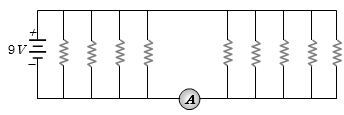
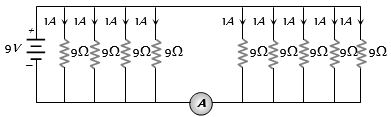
If each resistance in the figure is of $9\,\Omega$ then reading of ammeter is ............ $A$
Medium


Download our appand get started for free
Experience the future of education. Simply download our apps or reach out to us for more information. Let's shape the future of learning together!No signup needed.*
Similar Questions
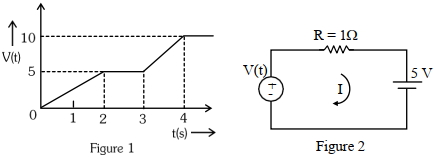
- 1For the circuit shown, the value of current at time ${t}=3.2\, {s}$ will be ...... ${A}$.View Solution
[Voltage distribution $V(t)$ is shown by Fig. $(1)$ and the circuit is shown in Fig. $(2)$]
- 2The resistance of a $5\, cm$ long wire is $10\, \Omega$. It is uniformly stretched so that its length becomes $20\, cm$. The resistance of the wire is ............. $\Omega$View Solution
- 3A cell of internal resistance $r$ drives current through an external resistance $R$ . The power delivered by the cell to the external resistance will be maximum when:View Solution
- 4The resistances of the four arms $P, Q, R$ and $S$ in a Wheatstone's bridge are $10\,ohm$, $30\,ohm$, $30\,ohm$ and $90\,ohm$, respectively. The e.m.f. and internal resistance of the cell are $7\,volt$ and $5\,ohm$ respectively. If the galvanometer resistance is $50\,ohm$, the current drawn from the cell will be ............... $A$View Solution
- 5$12$ cells each having same $emf$ are connected in series with some cells wrongly connected. The arrangement is connected in series with an ammeter and two cells which are in series. Current is $3 \,A$ when cells and battery aid each other and is $2\, A$ when cells and battery oppose each other. The number of cells wrongly connected isView Solution
- 6View SolutionAssertion : Bending a wire does not effect electrical resistance.
Reason : Resistance of wire is proportional ot resistivity of material.
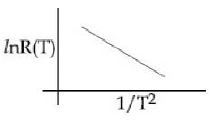
- 7View SolutionIn an experiment, the resistance of a material is plotted as a function of temperature (in some range). As shown in the figure, it is a straight line. One may conclude that:
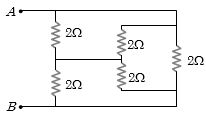
- 8Find the equivalent resistance across $AB$ .............. $\Omega$View Solution
- 9A rod of a certain metal is $1.0\, m$ long and $0.6\, cm$ in diameter. Its resistance is $3.0 × {10^{ - 3}}\, ohm$. Another disc made of the same metal is $2.0\, cm$ in diameter and $1.0\, mm$ thick. What is the resistance between the round faces of the discView Solution
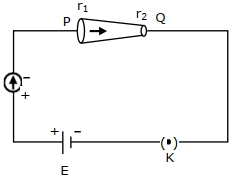
- 10In the given figure, a battery of emf $E$ is connnected across a conductor $P Q$ of length $'Y'$ and different area of cross-sections having radii $r_{1}$ and $r_{2}\left(r_{2}\,<\,r_{1}\right)$.View Solution
Choose the correct option as one moves from $P$ to $Q$ :