MCQ
If eight identical drops are joined to form a bigger drop, the potential on bigger as compared to that on smaller drop will be
  • A
    Double
  • Four times
  • C
    Eight times
  • D
    One time

Answer

Correct option: B.
Four times
b
(b) $V = {n^{2/3}}V$$ = {(8)^{2/3}}V = 4\,V$ i.e. $4 $ times.

Need a full question paper?

Generate a complete, print-ready paper with questions like this in minutes — across 16+ boards, with answer keys.

Start Generating Free

Similar questions

Out of the two cars $A$ and $B$, car $A$ is moving towards east with a velocity of $10 \,m / s$ whereas $B$ is moving towards north with a velocity $20 \,m / s$, then velocity of A w.r.t. $B$ is ......... $m / s$ (nearly)
The tension of a stretched string is increased by $69\%$. In order to keep its frequency of vibration constant, its length must be increased by .... $\%$
Two very long straight parallel wires, parallel to $y-$ axis,carrycurrents $4I$ and $I,$ along $+y$ directionand$-y$ direction, respectively. The wires are passes through the $x-$axis at the points $(d, 0, 0)$ and $(- d, 0, 0)$ respectively.The graph of magnetic field $z-$component as one moves along the $x-$axis from $x=- d$ to $x= +d,$ is best given by
The minimum charge on an object is
The direction of magnetic lines of forces close to a straight conductor carrying current will be
A cylindrical copper rod has length $L$ and resistance $R$. If it is melted and formed into another rod of length $2 L$, then the resistance will be ....... $R$
Given below are two statements:

Statement $I:$ Acceleration due to earth's gravity decreases as you go 'up' or 'down' from earth's surface.

Statement $II:$ Acceleration due to earth's gravity is same at a height ' $h$ ' and depth ' $d$ ' from earth's surface, if $h = d$.

In the light of above statements, choose the most appropriate answer form the options given below

In a Coolidge tube experiment, the minimum wavelength of the continuous $X-$ ray spectrum is equal to $66.3\, pm,$ then
One end of a $2.35\,\,m$ long and $2.0\,\,cm$ radius aluminium rod$(K = 235 \,\,W.m^{-1}K^{-1})$ is held at $20^0\,\,C$. The other end of the rod is in contact with a block of ice at its melting point. The rate in $kg.s^{-1}$ at which ice melts is

[Take latent heat of fusion for ice as $\frac{{10}}{3} ×10^5 J.kg^{-1} $]
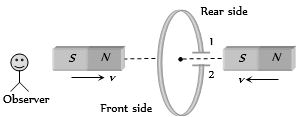
The north and south poles of two identical magnets approach a coil, containing a condenser, with equal speeds from opposite sides. Then