MCQ
If for two vectors $\overrightarrow A $ and $\overrightarrow B ,\overrightarrow A \times \overrightarrow B = 0,$ the vectors
  • A
    Are perpendicular to each other
  • Are parallel to each other
  • C
    Act at an angle of $60^°$
  • D
    Act at an angle of $30^°$

Answer

Correct option: B.
Are parallel to each other
b
(b) $\vec A \times \vec B = 0$ $⇒$ $\sin \theta = 0$ $⇒$ $\theta = 0^\circ $

Two vectors will be parallel to each other.

Need a full question paper?

Generate a complete, print-ready paper with questions like this in minutes — across 16+ boards, with answer keys.

Start Generating Free

Similar questions

The working of dynamo is based on principle of
Two parallel infinite line charges with linear charge densities $+\lambda\; \mathrm{C} / \mathrm{m}$ and $-\lambda\; \mathrm{C} / \mathrm{m}$ are placed at a distance of $2 \mathrm{R}$ in free space. What is the electric field mid-way between the two line charges?
If a $2\, kW$ boiler is used everyday for $1$ hour, then electrical energy consumed by boiler in thirty days is .......... $uint$
The insulated spheres of radii ${R_1}$ and ${R_2}$ having charges ${Q_1}$and ${Q_2}$ respectively are connected to each other. There is
A bar magnet is released from rest along the axis of a very long vertical copper tube. After some time the magnet will
An air bubble of radius 0.1 cm lies at a depth of 20 cm below the free surface of a liquid of density $1000 \mathrm{~kg} / \mathrm{m}^{3}$. If the pressure inside the bubble is $2100 \mathrm{~N} / \mathrm{m}^{2}$ greater than the atmospheric pressure, then the surface tension of the liquid in SI unit is (use $\mathrm{g}=10 \mathrm{~m} / \mathrm{s}^{2}$ )
Learned Indian classical vocalists do not like the accompaniment of a harmonium because
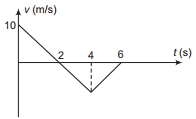
For the velocity-time graph shown in the figure, in a time interval from $t=0$ to $t=6\,s$, match the following columns.
Colum $I$ Colum $II$
$(A)$ Change in velocity $(p)$ $-5 / 3\,Sl$ unit
$(B)$ Average acceleration $(q)$ $-20\,SI$ unit
$(C)$ Total displacement $(r)$ $-10\,SI$ unit
$(D)$ Acceleration at $t=3\,s$ $(s)$ $-5\,SI$ unit

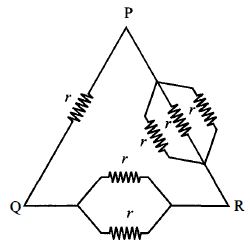
Six equal resistances are connected between points $P, Q$ and $R$ as shown in figure. Then net resistance will be maximum between
The water rises in the capillary to a height of $10\, cm$. If the surface tension of water is $73 \times 10^{-3}\, N/m$, density is $10^3\, kg/m^3$ and $g = 9.8\, m/sec^2$, then find radius of capillary