Question
If $\frac{4}{5}$, $a, 2$ are three consecutive terms of an A.P.?

Answer

Here, we are given three consecutive terms of an A.P.
First term $(a_1)$ = $\frac{4}{5}$
Second term $(a_2) = a$
Third term $(a_3) = 2$
We need to find the value of a. So, in an A.P. the difference of two adjacent terms is always constant. So, we get,
$d = a_2 - a_1$​​​​​​​
$\text{d}=\text{a}-\frac{4}{5}\ ....\text{(i)}$
Also,
$d = a_3 - a_2$
$d = 2 - a$
Now, on equating (i) and (ii), we get,
$\text{a}-\frac{4}{5}=2-\text{a}$
$\text{a}+\text{a}=2+\frac{4}{5}$
$2\text{a}=\frac{10+4}{5}$
$\text{a}=\frac{14}{10}$
$\text{a}=\frac{7}{5}$
Therefore, $\text{a}=\frac{7}{5}$.

Need a full question paper?

Generate a complete, print-ready paper with questions like this in minutes — across 16+ boards, with answer keys.
Start Generating Free

Similar questions

Solve the following equations by Cramer’s method.
7x + 3y = 15; 12y – 5x = 39
Solve the following quadratic equation:$\text{10x}-\frac{1}{\text{x}}=3$
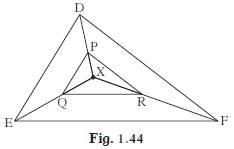
In the figure 1.44, X is any point in the interior of triangle. Point X is joined to vertices of triangle. Seg PQ || seg DE, seg QR || seg EF. Fill in the blanks to prove that, seg PR || seg DF.

Proof: IN $\triangle XDE , PQ \| DE$ $\square$
$\therefore \frac{ XP }{\square}=\frac{\square}{ QE }$
(Basic proportionality theorem)
In $\triangle XDE , QR \| EF......... \square$
$\therefore$ $\frac{\square}{\square}=\frac{\square}{\square}...............(ii)\square$
$\therefore$ $\frac{\square}{\square}=\frac{\square}{\square}...............$ from (i) and (ii)
$\therefore \text { seg PR\|seg DE .......... }$
(converse of basic proportionality theorem)
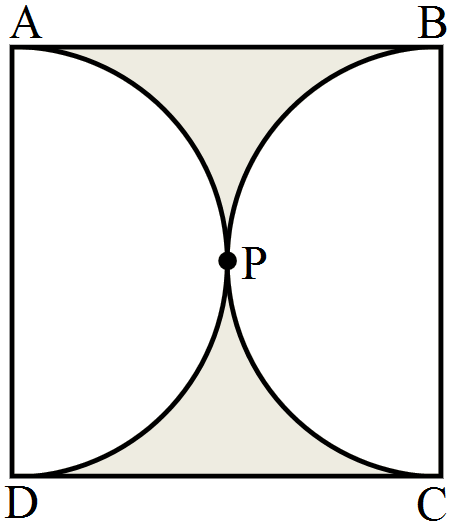
In the given figure, find the area of the shaded region, if ABCD is a square of side 14cm and APO and BPC are semicircles.
The radii of two circles are $19\ cm$ and $9\ cm$ respectively. Find the radius and area of the circles which has it circumference equal to the sum of the circumferences of the two circles.
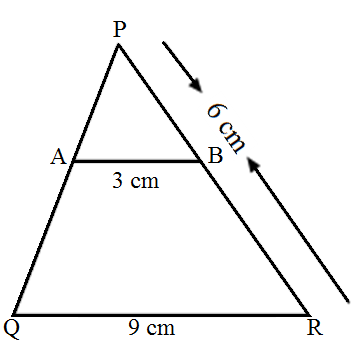
In the given figure, AB || QR. Find the length of PB.
Prove the following trigonometric identities.
$\frac{1+\cos\theta+\sin\theta}{1+\cos\theta-\sin\theta}=\frac{1+\sin\theta}{\cos\theta}$
Evaluate the following:
Verify the following:
$2\sin45^\circ\cos45^\circ=\sin90^\circ$
Find the value of k for which the root are real and equal in the following equations:
$3x^2 - 5x + 2k = 0$
A hemispherical depression is cut out from one face of a cubical wooden block of edge $21\ cm$, such that the diameter of the hemisphere is equal to the edge of the cube. Determine the volume and total surface area of the remaining block.