MCQ
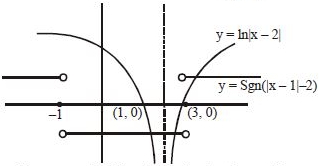
If $f(x) = \cos \left( {{{\tan }^{ - 1}}\left( {\sin \left( {{{\cos }^{ - 1}}x} \right)} \right)} \right) + \sin \left( {{{\cot }^{ - 1}}\left( {\cos \left( {{{\sin }^{ - 1}}x} \right)} \right)} \right)$ has range $\left[ {m,M),} \right.$ then number of solutions of the equation $\operatorname{sgn} \left( {\left| {x - 1} \right| - 2} \right) = \ln \left| {x - 2} \right|$ is (where sgn denotes signum function)
  • A
    $m^2+1$
  • B
    $m^2-M$
  • C
    $M^2+1$
  • $m^2+M$

Answer

Correct option: D.
$m^2+M$
d
$f(x)=\cos \left(\tan ^{-1}\left(\sin \left(\cos ^{-1} x\right)\right)\right)$

$+\sin \left(\cot ^{-1}\left(\cos \left(\frac{\pi}{2}-\cos ^{-1} x\right)\right)\right)$

$=\cos \left(\tan ^{-1}\left(\sin \left(\cos ^{-1} x\right)\right)\right)+\sin \left(\cot ^{-1}\left(\sin \left(\cos ^{-1} x\right)\right)\right)$

$=\cos \left(\tan ^{-1}\left(\sin \left(\cos ^{-1} x\right)\right)\right)+\sin \left(\frac{\pi}{2}-\tan ^{-1}\left(\sin \left(\cos ^{-1} x\right)\right)\right)$

$=\cos \left(\tan ^{-1}\left(\sin \left(\cos ^{-1} x\right)\right)\right)+\cos \left(\tan ^{-1}\left(\sin \left(\cos ^{-1} x\right)\right)\right)$

$=2 \cos \left(\tan ^{-1}\left(\sin \left(\cos ^{-1} x\right)\right)\right)=\frac{2}{\sqrt{2-x^{2}}} \in[\sqrt{2}, 2]$

From graph, Number of solutions of 

Sgn $\left( {\left| {x - 1} \right| - 2} \right) = \ln \left| {x - 2} \right|$ is $4$

Need a full question paper?

Generate a complete, print-ready paper with questions like this in minutes — across 16+ boards, with answer keys.

Start Generating Free

Similar questions

Let â be a unit vector perpendicular to the vectors $\overrightarrow{ b }=\hat{ i }-2 \hat{ j }+3 \hat{ k }$ and $\overrightarrow{ c }=2 \hat{ i }+3 \hat{ j }-\hat{ k }$, and makes an angle of $\cos ^{-1}\left(-\frac{1}{3}\right)$ with the vector $\hat{ i }+\hat{ j }+\hat{ k }$. If $\hat{ a }$ makes an angle of $\frac{\pi}{3}$ with the vector $\hat{ i }+\alpha \hat{ j }+\hat{ k }$, then the value of $\alpha$ is :
If the vectors $ai + bj + ck$ and $pi + qj + rk$ are perpendicular, then
The period of the function $f(x) = e^{x -[x]+|cos\, \pi x|+|cos\, 2\pi x|+....+|cos\, n\pi x|}$ (where $[.]$ denotes greatest integer function); is:-
For each positive integer $n$, defined $f_n(x)=$ minimum $\left(\frac{x^n}{n !}, \frac{(1-x)^n}{n !}\right)$, for $0 \leq x \leq 1 .$ Let $I_n=\int \limits_0^1 f_n(x) d x, n \geq 1$. Then, $\sum \limits_{n=1}^{\infty} I_n$ is equal to
A rectangle has one side on the positive $y-$ axis and one side on the positive $x -$ axis. The upper right hand vertex on the curve $y =\frac{{\ell nx}}{{{x^2}}}$ . The maximum area of the rectangle is
For $x, t \in R$ let $p_t(x)=(\sin t) x^2-(2 \cos t) x+\sin t$ be a family of quadratic polynomials in $x$ with variable coefficients. Let $A(t)=\int \limits_0^1 p_t(x) d x$. Which of the following statements are true?

$I$. $A(t) < 0$ for all $t$.

$II$. $A(t)$ has infinitely many critical points.

$III.$ $A(t)=0$ for infinitely many $t$.

$IV$. $A^{\prime}(t) < 0$ for all $t$.

Interval in which function $y = |x^2 -|x| -2|$ is non monotonic, can be-
What will be the equation of that chord of ellipse $\frac{{{x^2}}}{{36}} + \frac{{{y^2}}}{9} = 1$ which passes from the point $(2,1)$ and bisected on the point
$\int_{}^{} {x\sqrt {2x + 3} } \;dx = $
The term independent of $x$ in the expansion of ${\left( {2x + \frac{1}{{3x}}} \right)^6}$ is