MCQ
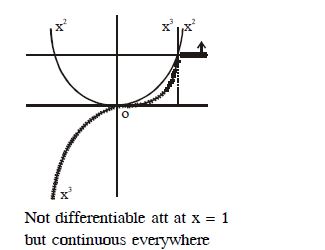
If $f(x)\ =$ min. $\{1, x^2, x^3\},$ then
  • A
    $f(x)$ is discontinuous $\forall \,x\, \in \,R$
  • B
    $f(x) > 0$  $\forall \,x\, \in \,R$
  • $f(x)$ is not differentiable but continuous $\forall \,x\, \in \,R$
  • D
    $f(x)$ is not differentiable for two values of $x$
Answer

Correct option: C.
$f(x)$ is not differentiable but continuous $\forall \,x\, \in \,R$
c

Need a full question paper?

Generate a complete, print-ready paper with questions like this in minutes — across 16+ boards, with answer keys.

Start Generating Free

Similar questions

Let a set $A=A_{1} \cup A_{2} \cup \ldots \cup A_{k,} \quad$ where $A_{ i } \cap A _{ j }=\phi$ for $i \neq j 1 \leq i , j \leq k$. Define the relation $R$ from $A$ to $A$ by $R=\left\{(x, y): y \in A_{i}\right.$ if and only if $\left.x \in A_{i}, 1 \leq i \leq k\right\}$. Then, $R$ is
If $\mathop {\lim }\limits_{x \to 0} \frac{{\ln \left( {1 + x} \right) - ax}}{{{x^2}}} = l$, then the value of $(a + l)$ is equal to (where $l$ is a finite number)
If the ellipse $\frac{ x ^{2}}{ a ^{2}}+\frac{ y ^{2}}{ b ^{2}}=1$ meets the line $\frac{x}{7}+\frac{y}{2 \sqrt{6}}=1$ on the $x$-axis and the line $\frac{x}{7}-\frac{y}{2 \sqrt{6}}=1$ on the $y$-axis, then the eccentricity of the ellipse is
For the curve $C :$ $\left(x^{2}+y^{2}-3\right)+\left(x^{2}-y^{2}-1\right)^{5}=0$, the value of $3 y^{\prime}-y^{3} y^{\prime \prime}$, at the point $(\alpha, \alpha), \alpha>0$, on $C$, is equal to.
If $\omega $ is a complex cube root of unity, then $225 + $${(3\omega + 8{\omega ^2})^2}$$ + {(3{\omega ^2} + 8\omega )^2} = $
Let $l = \mathop {Lim}\limits_{x \to {0^ + }} x^m (ln\,\, x)^n$ where $m, n \in N$ then :
$\prod\limits_{n = 1}^{10} {\left( {\frac{{\left( {6\sum\limits_{i = 0}^n i } \right) + 1}}{{\left( {6\sum\limits_{j = 0}^n {(j - 1)} } \right) + 1}}} \right)} $ equals to
If $3{\sin ^{ - 1}}\frac{{2x}}{{1 - {x^2}}} - 4{\cos ^{ - 1}}\frac{{1 - {x^2}}}{{1 + {x^2}}} + 2{\tan ^{ - 1}}\frac{{2x}}{{1 - {x^2}}} = \frac{\pi }{3}$ then $x$ =
If the solution curve of the differential equation $\left(\left(\tan ^{-1} y\right)-x\right) d y=\left(1+y^{2}\right) d x$ passes through the point $(1,0)$ then the abscissa of the point on the curve whose ordinate is $\tan \;(1)$ is
The corner points of the bounded feasible region are $(0,0),(2,0),(4,2),(2,4)$ and $\left(0, \frac{10}{3}\right)$

Then for the objective function $z=-x+2 y$

$(i)$ Maximum value of $z$ has at $\ldots \ldots \ldots . . .$

$(ii)$ Minimum value of $z$ has at $\ldots \ldots \ldots . . .$

$(iii)$ The maximum value of $z$ is $\ldots \ldots \ldots . . .$

$(iv)$ The minimum value of $z$ is $\ldots \ldots \ldots . . .$