MCQ
If $f(x) = \sin^2x$ and the composite function $\text{g(f(x))} = |\sin\text{x}|,$ then $g(x)$ is equal to:
  • A
    $\sqrt{\text{x}-1}$
  • $\sqrt{\text{x}}$
  • C
    $\sqrt{\text{x}+1}$
  • D
    $-\sqrt{\text{x}}$

Answer

Correct option: B.
$\sqrt{\text{x}}$
Given that $\text{f(x)}=\sin^2\text{x}$ and the composite function $\text{g(f(x))}=|\sin\text{x}|$
We will do it using trial and error method.
If we take $\text{g(x)}=-\sqrt{\text{x}}$ and $\text{f(x)}=\sin^2\text{x}$
$\text{g(f(x))}=\text{g}(\sin^2\text{x})$
$=-\sin\text{x}$
Which contradicts to the $\text{g(f(x))}=|\sin\text{x}|$
Hence, we take $\text{g(x)}=\sqrt{\text{x}}$
$\text{g(f(x))}=\text{g}(\sin^2\text{x})$
$=\sqrt{\sin^2\text{x}}=|\sin\text{x}|$

Need a full question paper?

Generate a complete, print-ready paper with questions like this in minutes — across 16+ boards, with answer keys.
Start Generating Free

Similar questions

The value of $k$  for which the function $f(x)=\left\{\begin{array}{cll}\frac{1-\cos 4 x}{8 x^2}, & \text { if } & x \neq 0 \\ k, & \text { if } & x=0\end{array}\right.$ is continuous at $x=0$ is
$f : R \rightarrow R$ is defined by $\text{f(x)}=\frac{\text{e}^{\text{x}^2}-\text{e}^{-\text{x}^2}}{\text{e}^{\text{x}^2}+\text{e}^{-\text{x}^2}}$ is:
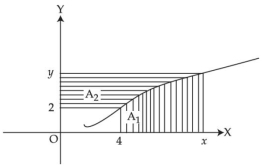
Consider a curve $y=y(x)$ in the first quadrant as shown in the figure. Let the area $A_{1}$ is twice the area $A _{2}$. Then the normal to the curve perpendicular to the line $2 x -12 y =15$ does NOT pass through the point.
The area (in sq. units ) of the region $\{ \left( {x,y} \right):x \ge 0,x + y \le 3,{x^2} \le 4y$ and $y \le 1 + \sqrt x \;\} $ is . . .
If $d$ is the determinant of a square matrix $A$ of order $n,$ then the determinant of its adjoint is:
Let $n$ be a natural number and let $a$ be a real number. The number of zeroes of $x^{2 n+1}-(2 n+1) x+a=0$ in the interval $[-1,1]$ is
Let the image of the point $P (1,2,3)$ in the line $L : \frac{ x -6}{3}=\frac{ y -1}{2}=\frac{ z -2}{3}$ be $Q .$ let $R (\alpha, \beta, \gamma)$ be a point that divides internally the line segment $PQ$ in the ratio $1: 3$. Then the value of $22(\alpha+\beta+\gamma)$ is equal to
If $A = \left\{ {1,2,3,......m} \right\},$ then total number of reflexive relations that can be defined from $A \to A$ is 
Let * be a binary operation on N defined by a * b = a + b + 10 for all a, b ∈ N. The identity element for * in N is:
Evaluate $\begin{bmatrix}5&0&5\\1&4&3\\0&8&6\end{bmatrix}$ is: