MCQ
If $f(x)=x^3-15 x^2+84 x-17$, then ______.
  • A
    f(x) is increasing in `(-oo, 10]` and decreasing in `[10, oo)`
  • B
    f(x) is decreasing in `(-oo, 10]` and increasing in `[10, oo)`
  • f(x) is increasing throughout real line
  • D
    f(x) is decreasing throughout real line
Answer

Correct option: C.
f(x) is increasing throughout real line
C

Need a full question paper?

Generate a complete, print-ready paper with questions like this in minutes — across 16+ boards, with answer keys.

Start Generating Free

Similar questions

Maltose is composed of ______.
The correct description for the interspecific interaction shown in the given figure is ______
Image
Which of the following is/are included in the external genitalia of the female reproductive system?
Which of the following properties is NOT of lanthanoids?
How the linear velocity 'v' of an electron in the Bohr orbit is related to its quantum number 'n'?
A cylindrical magnetic rod has length 5 cm and diameter 1 cm. It has uniform magnetization$5.3 \times 10^3 \frac{ A }{ m ^3}$. Its net magnetic dipole moment is nearly $\left(\pi=\frac{22}{7}\right)$.
The mutual inductance between two coplanar concentric rings $A$ and $B$ of radii $ 'R_1\ ' $ and $'R_2\ '$ placed in air when a current $ 'I\ '$ flows through ring $A$ is $(R_1 >> R_2) (µ_0 =$ permeability of free space$) ........$
Statement I: If one or two species are lost, it may not affect proper functioning of ecosystem.

Statement II: Loss of key species causes serious threat to functioning of ecosystem. Choose the correct alternative with reference to the above statements

The heat evolved in the combustion of benzene is given by$\ce{C6H6 + 7 1/2O2 -> 6CO2_{(g)} + 3H2O_{(l)}}$; ΔH = −3264.6 kJ
Which of the following quantities of heat energy will be evolved when $39 \mathrm{~g} \mathrm{~C}_6 \mathrm{H}_6$ are burnt?
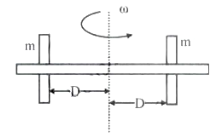
Two identical masses are connected to a horizontal thin (massless) rod as shown in the figure. When their distance from the pivot is $D$, a torque $\tau$ produces an angular acceleration of $\alpha_1$. The masses are now repositioned so that they are 2 D from the pivot. The same torque produces an angular acceleration $\alpha_2$ which is given by  ______ 
Image