MCQ
If $f(x) = x^4+ \lambda x^3 +x^2$ $(\lambda \in R)$ has local maximum at $\frac{1}{2} ,$ then absolute minimum value of $f(x)$ is -
  • A
    $-4$
  • $0$
  • C
    $4$
  • D
    $-16$

Answer

Correct option: B.
$0$
b
$f^{\prime}(x)=4 x^{3}+3 \lambda x^{2}+2 x$

$\because f^{\prime}\left(\frac{1}{2}\right)=0 \Rightarrow \lambda=-2$

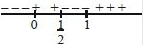
$\Rightarrow f^{\prime}(x)=2 x(2 x-1)(x-1)$

minimum value $=f(0)=f(1)=0$
Need a full question paper?

Generate a complete, print-ready paper with questions like this in minutes — across 16+ boards, with answer keys.

Start Generating Free

Similar questions

The solution of $tan\,\, 2\theta\,\, tan\theta = 1$ is
Let $P$ and $Q$ be distinct points on the parabola $y^2=2 x$ such that a circle with $P Q$ as diameter passes through the vertex $O$ of the parabola. If $P$ lies in the first quadrant and the area of the triangle $\Delta O P Q$ is $3 \sqrt{2}$, then which of the following is (are) the coordinates of $P$ ?

$(A)$ $(4,2 \sqrt{2})$ $(B)$ $(9,3 \sqrt{2})$ $(C)$ $\left(\frac{1}{4}, \frac{1}{\sqrt{2}}\right)$ $(D)$ $(1, \sqrt{2})$

$\int_{}^{} {\frac{{\tan x}}{{\sec x + \tan x}}\;dx = } $
If $A$ is the area of the region bounded by the curve $y = \sqrt {3x + 4} $, $x$ axis and the line $x = - 1$ and $x = 4$ and $B$ is that area bounded by curve ${y^2} = 3x + 4$, $x -$ axis and the lines $x = - 1$ and $x = 4$ then $A:B$ is equal to
$\int\limits_{ - 1}^{\frac{3}{2}} {|x\sin \pi x|dx} $ equals
A random variable $X$ has the probability distribution  ....For the events $E = \{ X$is prime number $\}$ and $F = \{ X < 4\} $, the probability of $P(E \cup F)$ is
$X$ $1$ $2$ $3$ $4$ $5$ $6$ $7$ $8$
$P(X)$ $0.15$ $0.23$ $0.12$ $0.10$ $0.20$ $0.08$ $0.07$ $0.05$
Let $f:\left[ {4,\infty } \right) \to \left[ {1,\infty } \right)$ be a function defined by $f\left( x \right) = {5^{x\left( {x - 4} \right)}}$  then $f^{-1}(x)$  is
If $f(y) = {e^y},\,g(y) = y;\,y > 0$ and $F(t) = \int_{\,0}^{\,t} {\,f(t - y)\,g(y)\,dy,} $ then
Let $a_1, a_2, \ldots \ldots, a_n$ be in A.P. If $a_5=2 a_3$ and $a_{11}=18$, then $12\left(\frac{1}{\sqrt{a_{10}}+\sqrt{a_{11}}}+\frac{1}{\sqrt{a_{11}}+\sqrt{a_{12}}}+\ldots . \cdot \frac{1}{\sqrt{a_{17}}+\sqrt{a_{18}}}\right)$ is equal to $..........$.
The value of $\sum_{r-1}^{18} cos^2(5r)^o,$  where $x^o $ denotes the $x$ degree, is equals to