MCQ
If $f(x) = x{e^{x(1 - x)}}$, then $f(x)$ is
- ✓Increasing on $\left[ { - {1 \over 2},\,1} \right]$
- BDecreasing on $ R$
- CIncreasing on $ R$
- DDecreasing on $\left[ { - {1 \over 2},1} \right]$
$ = \,\,{e^{x(1 - x)}}\{ 1 + x(1 - 2x)\} = {e^{x(1 - x)}}.( - 2{x^2} + x + 1)$
Now by the sign-scheme for $ - 2{x^2} + x + 1$
$f'(x) \ge 0,$ if $x\, \in \,\left[ { - \frac{1}{2},\,1} \right],$ because ${e^x}(1 - x)$ is always positive.
So, $f(x)$ is increasing on $\left[ { - \frac{1}{2},\,1} \right]$.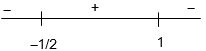
Generate a complete, print-ready paper with questions like this in minutes — across 16+ boards, with answer keys.
$ 11 x+y+\lambda z=-5 $
$ 2 x+3 y+5 z=3 $
$ 8 x-19 y-39 z=\mu$
has infinitely many solutions, then $\lambda^4-\mu$ is equal to :