MCQ
If $f(x)=\int_{0}^{x} t \sin t \,d t,$ then $f^{\prime}(x)$ is
  • A
    $\cos \,x+x \sin\, x$
  • $x\, \sin \,x$
  • C
    $x\, \cos \,x$
  • D
    $\sin\, x+x \,\cos \,x$

Answer

Correct option: B.
$x\, \sin \,x$
b
$f(x)=\int_{0}^{x} t \sin t d t$

Integrating by parts, we obtain

$f(x)=t \int_{0}^{x} \sin t d t-\int_{0}^{x}\left\{\left(\frac{d}{d t} t\right) \int \sin t \, d t\right\} d t$

$=[t(-\cos t)]_{0}^{x}-\int_{0}^{x}(-\cot t) d t$

$=[-t \cos t+\sin t]_{0}^{x}$

$=-x \cos x+\sin x$

$\Rightarrow f^{\prime}(x)=-[\{x(-\sin x)\}+\cos x]+\cos x$

$=x \sin x-\cos x+\cos x$

$=x \sin x$

Hence, the correct Answer is $B$

Need a full question paper?

Generate a complete, print-ready paper with questions like this in minutes — across 16+ boards, with answer keys.
Start Generating Free

Similar questions

The least and greatest value of $f(x) = x^3 - 6x^2+ 9x$ in $[0, 6]$, are.
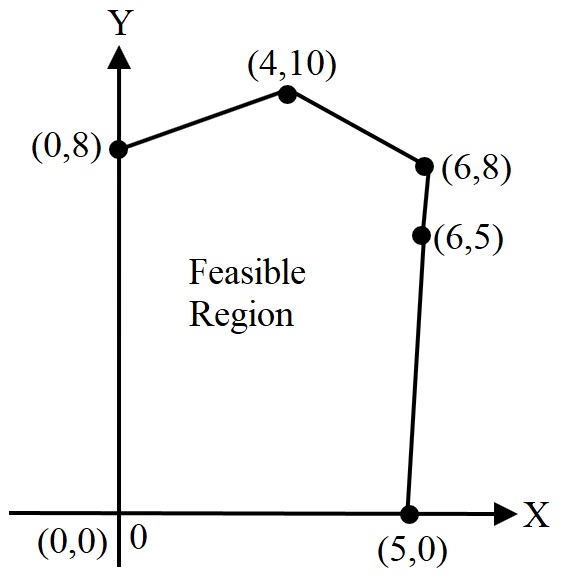
The feasible, region for an LPP is shown shaded in the figure. Let Z = 3x - 4y be the objective function. A minimum of Z occurs at:
The number of positive integral solutions of the equation $\left| {\begin{array}{*{20}{c}}{{x^3} + 1}&{{x^2}y}&{{x^2}z}\\{x{y^2}}&{{y^3} + 1}&{{y^2}z}\\{x{z^2}}&{y{z^2}}&{{z^3} + 1}\end{array}} \right|$ $= 11$ is
The area bounded by a curve, the axis of co-ordinates $\&$ the ordinate of some point of the curve is equal to the length of the corresponding arc of the curve. If the curve passes through the point $P (0, 1)$ then the equation of this curve can be
Let $D$ be the domain of the function $f(x)=\sin ^{-1}$ $\left(\log _{3 x}\left(\frac{6+2 \log _3 x}{-5 x}\right)\right)$. If the range of the function $g: D \rightarrow R$ defined by $g( x )= x -[ x ],([ x ]$ is the greatest integer function), is ( $\alpha, \beta)$, then $\alpha^2+\frac{5}{\beta}$ is equal to
The probability that a leap year will have 53 fridays or 53 Saturdays is.
The point $B$ divides the arc $AC$ of a quadrant of a circle in the ratio $1 : 2$. If $O$ is the centre and $\overrightarrow {OA} = a$ and $\overrightarrow {OB} = b,$ then the vector $\overrightarrow {OC} $ is
The integral $\int \frac{(2 x-1) \cos \sqrt{(2 x-1)^{2}+5}}{\sqrt{4 x^{2}-4 x+6}} d x$ is equal to (where $c$ is a constant of integration)
Choose the correct answer from the given four options. Let $f : [2, \infty ) \rightarrow R$ be the function defined by $f(x) = x^2– 4x + 5$, then the range of $f$ is:
The value of the integral $\int\limits^\infty_0\frac{\text{x}}{(1+\text{x})(1+\text{x}^2)}\text{dx}$ is: