MCQ
If $\hat{i}$ denotes a unit vector along incident light ray, $\hat{r}$ a unit vector along refracted ray into a medium of refractive index $\mu$ and $\hat{n}$ unit vector normal to boundary of medium directed towards incident medium, then law of refraction is
  • A
    $\hat{i} \cdot \hat{n}=\mu(\hat{r} \cdot \hat{n})$
  • B
    $\hat{i} \times \hat{n}=\mu(\hat{n} \times \hat{r})$
  • $\hat{i} \times \hat{n}=\mu(\hat{r} \times \hat{n})$
  • D
    $\mu(\hat{i} \times \hat{n})=\hat{r} \times \hat{n}$
Answer

Correct option: C.
$\hat{i} \times \hat{n}=\mu(\hat{r} \times \hat{n})$
Snell's law in vector form is $\hat{i} \times \hat{n}=\mu(\hat{r} \times \hat{n})$

Need a full question paper?

Generate a complete, print-ready paper with questions like this in minutes — across 16+ boards, with answer keys.

Start Generating Free

Similar questions

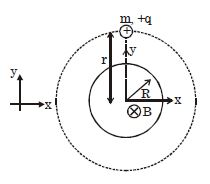
Circular region of radius $R$ has uniform magnetic field $B = {B_0} + {B_0}t\left( { - \hat k} \right).\,At\,\,t\, = 0\,$ acceleration of charged particle 
In open organ pipe, if fundamental frequency is $n$ then the other frequencies are
The escape velocity of a projectile from the earth is approximately
Two electric lamps of $40$ watt each are connected in parallel. The power consumed by the combination will be
Two waves are propagating to the point $P$ along a straight line produced by two sources $A$ and $B$ of simple harmonic and of equal frequency. The amplitude of every wave at $P$ is ' $a$ ' and the phase of $A$ is ahead by $\frac{\pi}{3}$ than that of $B$ and the distance $A P$ is greater than $B P$ by $50 \mathrm{~cm}$. Then the resultant amplitude at the point $P$ will be, if the wavelength is 1 meter
The largest distance between the interatomic planes of a crystal is 10 $\mathrm{cm}$. The upper limit for the wavelength of $X$-rays which can be usefully studied with this crystal is
A wave disturbance in a medium is described by $y(x, t)=0.02 \cos \left(50 \pi t+\frac{\pi}{2}\right) \cos (10 \pi x)$, where $x$ and $y$ are in metres and $t$ in seconds
If a body of mass $200 \mathrm{~g}$ falls from a height $200 \mathrm{~m}$ and its total P.E. is converted into K.E. at the point of contact of the body with earth surface, then what is the decrease in P.E. of the body at the contact $\left(g=10 \mathrm{~m} /\mathrm{s}^2\right)$
Energy in a current carrying coil is stored in the form of
A body freely falling from the rest has a velocity ' $v$ ' after it falls through a height ' $h$ '. The distance it has to fall down for its velocity to become double, is