Question
If $HN{O_3}$ changes into ${N_2}O$, the oxidation number is changed by

Answer

$HN{O_3}$      $ \rightleftharpoons $      $\mathop {{N_2}O}\limits^{ * \,\,\,\,\,\,} $
     $1 + x - 6 = 0$          $2x - 2 = 0$
     $x = + 5$                  $2x = 2$
                                      $x = \frac{2}{2} = + 1$

Need a full question paper?

Generate a complete, print-ready paper with questions like this in minutes — across 16+ boards, with answer keys.

Start Generating Free

Similar questions

$75\,\%$ of a first order reaction was completed in $32$ minutes when was $50\,\%$ of the reaction completed ......... $\min$
The molecular orbital configuration of a diatomic molecule is

$\sigma \,\,1{s^2}\,\,{\sigma ^*}\,\,1{s^2}\,\sigma \,\,2{s^2}\,{\sigma ^*}\,2{s^2}\,\,\sigma \,2p_x^2\,\left\{ {{}_{\pi \,2p_z^2}^{\pi \,2p_y^2}} \right.$ 

Its bond order is

The amount of electricity in Coulomb required for the oxidation of $1 \mathrm{~mol}$ of $\mathrm{H}_2 \mathrm{O}$ to $\mathrm{O}_2$ is .....................  ${10^5} \mathrm{C}$.
$1.22\, \mathrm{~g}$ of an organic acid is separately dissolved in $100 \,\mathrm{~g}$ of benzene $\left(\mathrm{K}_{\mathrm{b}}=2.6\, \mathrm{~K}\, \mathrm{~kg} \,\mathrm{~mol}^{-1}\right)$ and $100\, \mathrm{~g}$ of acetone $\left(\mathrm{K}_{b}=1.7\, \mathrm{~K} \,\mathrm{~kg} \,\mathrm{~mol}^{-1}\right) .$ The acid is known to dimerize in benzene but remain as a monomer in acetone. The boiling point of the solution in acetone increases by $0.17^{\circ} \mathrm{C}$.

The increase in boiling point of solution in benzene in ${ }^{\circ} \mathrm{C}$ is $\mathrm{x} \times 10^{-2}$. The value of $\mathrm{x}$ is ..... .(Nearest integer)

$[$ Atomic mass : $\mathrm{C}=12.0, \mathrm{H}=1.0, \mathrm{O}=16.0]$
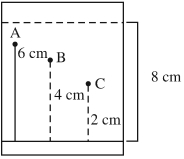
Three organic compounds $A , B$ and $C$ were allowed to run in thin layer chromatography using hexane and gave the following result (see figure). The $R_f$ value of the most polar compound is $............\,\times 10^{-2}$
$3\, mole\, N_2H_4$ will lose $30 \,mole$ electrons to give new compound. Calculate  oxidation state of $N$ in new compound? (Oxidation state of $H$ remains unchanged)
$2\, mole$ of $N_2H_4$ loses $16\, mole$ of electron is being converted to a new compound $X$. Assuming that all of the $N$ appears in the new compound. What is the oxidation state of $'N'$ in $X$ ?
The number of species from the following which are paramagnetic and with bond order equal to one is
$ H_2, He_2^{+}, O_2^{+}, N_2^{2-}, O_2^{2-}, F_2, Ne_2^{+}, B_2 $
The equivalent weight of phosphoric acid $({H_3}P{O_4})$ in the reaction $NaOH + {H_3}P{O_4} \to Na{H_2}P{O_4} + {H_2}O$ is
The reaction $2NO(g) + {O_2}(g)$ $\rightleftharpoons$ $2N{O_2}(g)$is of first order. If volume of reaction vessel is reduced to $1/3,$  the rate of reaction would be .......... times