Question
If $HN{O_3}$ changes into ${N_2}O$, the oxidation number is changed by

Answer

$HN{O_3}$      $ \rightleftharpoons $      $\mathop {{N_2}O}\limits^{ * \,\,\,\,\,\,} $
     $1 + x - 6 = 0$          $2x - 2 = 0$
     $x = + 5$                  $2x = 2$
                                      $x = \frac{2}{2} = + 1$

Need a full question paper?

Generate a complete, print-ready paper with questions like this in minutes — across 16+ boards, with answer keys.

Start Generating Free

Similar questions

The resistivity of a $0.8\,M$ solution of an electrolyte is $5 \times 10^{-3}\,\Omega\,cm$. Its molar conductivity is $.....\times 10^4 \Omega^{-1}\,cm ^2\,mol ^{-1}$. (Nearest integer)
Resistance of a decimolar solution between two electrodes $0.02$ $meter$ apart and $0.0004\,m^2$ in area was found to be $50\,ohm$. Specific conductance $(k)$ is : ........... $\mathrm{S\,m}^{-1}$
Total number of cis $N - Mn - Cl$ bond angles (that is, $Mn - N$ and $Mn - Cl$ bonds in cis positions) present. . . . $\left(e n= NH _2 CH _2 CH _2 NH _2\right)$
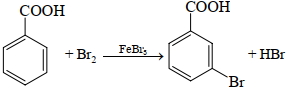
Consider the above reaction where $6.1 \,g$ of benzoic acid is used to get $7.8\, g$ of $m$ -bromo benzoic acid. The percentage yield of the product is ....... .

(Round off to the Nearest integer) [Given : Atomic masses : $C =12.0 \,u , H : 1.0\, u,O : 16.0 \,u , Br =80.0 \,u ]$
Number of bridging $CO$ ligands in $\left[ Mn _{2}( CO )_{10}\right]$ is .... .
The amount of electricity in Coulomb required for the oxidation of $1 \mathrm{~mol}$ of $\mathrm{H}_2 \mathrm{O}$ to $\mathrm{O}_2$ is .....................  ${10^5} \mathrm{C}$.
......... $c{m^3}$ is the volume of $0.1\,N\,HCl$ required to react completely with $1.0g$ of pure calcium carbonate $(Ca = 40,\,C = 12$ and $O = 16)$
In a zero-order reaction, for every $10\,^oC$ rise of temperature, the rate is doubled. If the temperature is increased from $10\,^o C$ to $100\,^o C,$ the rate of the reaction will become ....... times
Oxidation number of $S$ in ${S_2}C{l_2}$ is
An increase in temperature by ${10\,^o}C$, generally increases the rate of a reaction by .......... times