MCQ
If in Bohr's atomic model, it is assumed that force between electron and proton varies inversely as $r^4$, energy of the system will be proportional to
  • A
    $n^2$
  • B
    $n^4$
  • $n^6$
  • D
    $n^8$

Answer

Correct option: C.
$n^6$
c
$\frac{m v^2}{r}=\frac{k}{r^4}$

$V^2=\frac{k}{m r^3}$

we know

$m v r=\frac{n h}{2 x}$

$m^2 v^2 r^2=\frac{n^2 h^2}{4 \pi^2}$

$\frac{m^2 k r}{m r}=\frac{n^2 h^2}{4 x^2}$

$r=\frac{m k^3 \pi^2}{n^2 h^2}$

$k \cdot f=\frac{1}{2} m v^2=\frac{1}{2} m / \frac{k}{m r^3}$

$=\frac{1}{2} m^m \frac{K}{m^1 m^3}$

$E \alpha n^6$

Need a full question paper?

Generate a complete, print-ready paper with questions like this in minutes — across 16+ boards, with answer keys.
Start Generating Free

Similar questions

An engine of mass one metric ton is ascending on a inclined plane, at an angle $\theta=\tan ^{-1}\left(\frac{1}{2}\right)$ with horizontal, with a speed of $36 \;km / h$. If the coefficient of friction of surface is $\left(\frac{1}{\sqrt{3}}\right)$ then the power 
The coefficient of volumetric expansion of mercury is $18 × 10^{-5}{°C^{-1}}$. A thermometer bulb has a volume $10^{-6}\, m^3$ and cross section of stem is $ 0.004 \,cm^2$. Assuming that bulb is filled with mercury at $0°C$ then the length of the mercury column at $100°C$ is
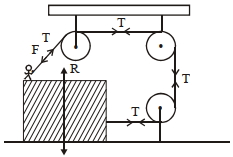
A boy of mass $4\, kg$ is standing on a piece of wood having mass $5 \,kg$. If the coefficient of friction between the wood and the floor is $0.5,$ the maximum force that the boy can exert on the rope so that the piece of wood does not move from its place is ......$N.$(Round off to the Nearest Integer) [Take $g=10 \,ms ^{-2}$ ]
If an ideal gas is compressed isothermally then
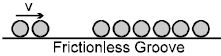
Six steel balls of identical size are lined up long a straight frictionless groove. Two similar balls moving with a speed $V$ along the groove collide with this row on the extreme left hand then
The root mean square speed of hydrogen molecules at $300$ $K$ is $1930\, m/s.$ Then the root mean square speed of oxygen molecules at $900\, K$ will be ....... $m/s$
Which of the following is the correct device for the detection of thermal radiation
Match the List $-I$ (Phenomenon associated with electromagnetic radiation) with List $-II$ (Part of electromagnetic spectrum) and select the correct code from the choices given below this lists
  List $I$   List $II$
$I$ Doublet of sodium $(A)$ Visible radiation
$II$ Wavelength corresponding to temperature associated with the isotropic radiation filling all space $(B)$ Microwave
$III$ Wavelength emitted by atomic hydrogen in interstellar space $(C)$ Short radio wave
$IV$ Wavelength of radiation arising from two close energy levels in hydrogen $(D)$ $X-$ rays
A ground receiver station is receiving a signal at $(i)$ $5\, MHz$ and transmitted from a ground transmitter at a height of $300\, m$, located at a distance of $100\, km$ from the receiver station. The signal is coming via. Radius of earth $= 6.4 \times 10^6\, m$. Nmax of isosphere = $10^{12} m_3$
A point moves in $x-y$ plane as per $x=kt,$ $y = kt\left( {1 - \alpha t} \right)$ where $k\,\& \,\alpha \,$ are $+ve$ constants. The equation of trajectory is