Question
If $\int\text{e}^{\text{x}}(\tan\text{x}+1)\sec\text{x dx}=\text{e}^{\text{x}}\text{ f}(\text{x})+\text{C},$ then write the value of f(x).

Answer

Since, $\int\text{e}^{\text{x}}\big(\text{f(x)}+\text{f}(\text{x})\big)\text{dx}=\text{e}^{\text{x}}\text{ f}(\text{x})+\text{C}$
We can write the expression as
$\int\text{e}^{\text{x}}(\tan\text{x}+1)\sec\text{x dx}=\text{e}^{\text{x}}\text{ f}(\text{x})+\text{C}$
$\int\text{e}^{\text{x}}(\sec\text{x}+\tan\text{x}\sec\text{x})\text{dx}=\text{f}(\text{x})\text{e}^{\text{x}}+\text{C}$
Comparing with equation $\int\text{e}^{\text{x}}(\sec\text{x}+\tan\text{x}\sec\text{x})\text{dx}=\text{f}(\text{x})\text{e}^{\text{x}}+\text{C}$ with standard equation we have
$\text{f(x)}=\sec\text{x},\text{f}'(\text{x})=\sec\text{x}\tan\text{x}$
Therefore,
$\int\text{e}^{\text{x}}(\sec\text{x}+\tan\text{x}\sec\text{x})\text{dx}=\text{e}^{\text{x}}\sec\text{x}+\text{C}$
Thus, $\text{f(x)}=\sec\text{x}$

Need a full question paper?

Generate a complete, print-ready paper with questions like this in minutes — across 16+ boards, with answer keys.

Start Generating Free

Similar questions

Find the value of k in this question, so that the function f is continuous at the indicated point:
$\text{f(x)}=\begin{cases}\frac{2^{\text{x}+2}-16}{4^\text{x}-16},&\text{if x}\neq2\\\text{k},&\text{if x}=2\end{cases}$ at x = 2.
Solve the following differential equations:

$2\text{x}\frac{\text{dy}}{\text{dx}}=5\text{y},\text{y}(1)=1$

Evaluate the following integrals:
$\int\limits^{\frac{\pi}{2}}_0\log\tan\text{x dx}$
Show that f : N $\rightarrow$  N, given by

f(x) = $\begin{matrix} \text{x + 1, if x is odd} & \\ \text{x - 1, if x is even} & \\ \end{matrix}$

is both one-one and onto.

Evaluate the following definite integrals:
$\int_{1}^\limits{2}\text{e}^{2\text{x}}\Big(\frac{1}{\text{x}}-\frac{1}{2\text{x}^2}\big)\text{dx}$
Evaluate the following integrals:

$\int\frac{1}{\text{x}^{\frac{2}{3}}\sqrt{\text{x}^{\frac{2}{3}}-4}}\text{ dx}$
Evaluate the following:
$\int\sqrt{5-2\text{x}+\text{x}^2}\text{dx}$
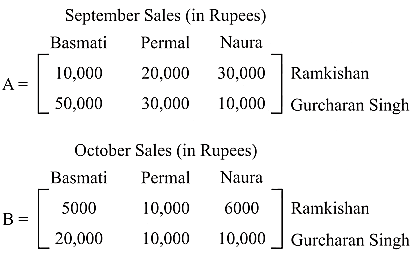
Two farmers Ramkishan and Gurcharan Singh cultivates only three varieties of rice namely Basmati, Permal and Naura. The sale (in Rupees) of these varieties of rice by both the farmers in the month of September and October are given by the following matrices A and B.

  1. Find the combined sales in September and October for each farmer in each variety.
  2. Find the decrease in sales from September to October.
  3. If both farmers receive 2% profit on gross sales, compute the profit for each farmer and for each variety sold in October.
If a function g = {(1, 1), (2, 3), (3, 5), (4, 7)} is described by $\text{g(x)}=\alpha\text{x}+\beta\alpha\text{x}+\beta,$ then find the values of $\alpha$ and $\beta.$
Determine which of the following binary operations are associative and which are commutative:
* on Q defined by $\text{a}\ ^*\ \text{b}=\frac{\text{a}+\text{b}}{2}$ for all $\text{a, b}\in\text{Q}$