MCQ
If $\int_{\log 2}^x {\frac{{du}}{{{{({e^u} - 1)}^{1/2}}}}} = \frac{\pi }{6}$, then ${e^x} = $
  • A
    $1$
  • B
    $2$
  • $4$
  • D
    $-1$

Answer

Correct option: C.
$4$
c
(c) $\int_{\log 2}^x {\frac{{du}}{{{{({e^u} - 1)}^{1/2}}}}} = \frac{\pi }{6}$

==> $\int_1^{\sqrt {{e^x} - 1} } {\frac{{2t}}{{1 + {t^2}}}} \;dt = \frac{\pi }{6}$

as ${e^u} - 1 = {t^2}$

==> $2({\tan ^{ - 1}}t)_1^{\sqrt {{e^x} - 1} } = \frac{\pi }{6}$

==> ${\tan ^{ - 1}}\sqrt {{e^x} - 1} - \frac{\pi }{4} = \frac{\pi }{{12}}$

==> $\sqrt {{e^x} - 1} = \tan \frac{\pi }{3}$ 

==> $\sqrt {{e^x} - 1} = \sqrt 3 $

==> ${e^x} = 4$.

Need a full question paper?

Generate a complete, print-ready paper with questions like this in minutes — across 16+ boards, with answer keys.
Start Generating Free

Similar questions

Let [x] denote the greatest integer less than or equal to x. If f(x) = sin-1x, g(x) = [x2] and $\text{h(x)}=2\text{x},\frac{1}{2}\leq\text{x}\leq\frac{1}{\sqrt{2}},$ then
  1. $\text{fogoh(x)}=\frac{\pi}{2}$
  2. $\text{fogoh(x)}=\pi$
  3. $\text{hofog}=\text{hogof}$
  4. $\text{hofog}\neq\text{hogof}$
$\int\limits_{ - 10}^{10} {\frac{{{3^x}}}{{{3^{[x]}}}}\,dx} $ is equal to, where $[·]$ is $G.I.F.$
$\lim _{x \rightarrow \frac{\pi}{4}} \frac{\int_2^{\sec ^2 x} f(t) d t}{x^2-\frac{\pi^2}{16}}$ equals
The function $f: R \rightarrow R$ defined by $f(x)=6^x+6^{|x|}$ is
Let $\vec{\alpha}=4 \hat{ i }+3 \hat{ j }+5 \hat{ k }$ and $\vec{\beta}=\hat{ i }+2 \hat{ j }-4 \hat{ k }$. Let $\vec{\beta}_1$ be parallel to $\vec{\alpha}$ and $\vec{\beta}_2$ be perpendicular to $\vec{\alpha}$. If $\vec{\beta}=\vec{\beta}_1+\vec{\beta}_2$, then the value of $5 \vec{\beta}_2 \cdot(\hat{ i }+\hat{ j }+\hat{ k })$ is
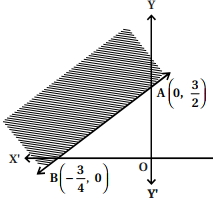
The shaded region in the given figure is a graph of $.....$
Choose the correct answer from the given four options.

The curve for which the slope of the tangent at any point is equal to the ratio of the abcissa to the ordinate of the point is:

  1. An ellipse.
  2. parabola.
  3. circle.
  4. rectangular hyperbola.
Which of the following functions form Z to itself are bijections?
  1. f(x) = x3
  2. f(x) = x + 2
  3. f(x) = 2x + 1
  4. f(x) = x2 + x
If the gradient of the tangent at any point $(x, y)$ of a curve which passes through the point $\left( {1,\,\frac{\pi }{4}} \right)$ is $\left\{ {\frac{y}{x} - {{\sin }^2}\left( {\frac{y}{x}} \right)} \right\},$ then equation of the curve is
The area of the region bounded by the parabola y = x2 + 1 and the straight line x + y = 3 is given by:
  1. $\frac{45}{7}\text{sq.}\text{units}$
  2. $\frac{25}{4}\text{sq.}\text{units}$
  3. $\frac{5}{18}\text{sq.}\text{units}$
  4. $\frac{9}{2}\text{sq.}\text{units}$