MCQ
If $L = 2.331\,cm,\;B = 2.1\,cm$, then $L + B = $
  • A
    $4.431 \,cm$
  • B
    $4.43 \,cm$
  • $4.4 \,cm$
  • D
    $4 \,cm$

Answer

Correct option: C.
$4.4 \,cm$
c
(c) Given, $L = 2.331\;cm$

$ = 2.33$ (correct upto two decimal places)

and $B = 2.1\;cm$$ = 2.10\;cm$

$\therefore \;L + B = 2.33 + 2.10 = 4.43\;cm$.$ = 4.4\,cm$

Since minimum significant figure is $2$.

Need a full question paper?

Generate a complete, print-ready paper with questions like this in minutes — across 16+ boards, with answer keys.
Start Generating Free

Similar questions

Which of the following statements is/are not an assumption of the kinetic theory for an ideal gas?
The door of a running refrigerator inside a room is left open. The correct statement out of the following ones is:
Given radius of Earth $‘R’$ and length of a day $‘T’$ the height of a geostationary satellite is [$G-$Gravitational Constant, $M-$Mass of Earth]
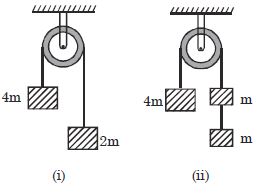
In the arrangement shown in figure, pulley is smooth and massles and all the strings are  light let $F_1$ be the force exerted on the pulley in case $(i)$ and $F_2$ the force in case $(ii)$. Then
A point mass oscillates along the x-axis according to the law $x=x_0cos$$\left( {\omega t - \frac{\pi }{4}} \right)$ If the acceleration of the particle is written as $a=Acos$$\left( {\omega t + \delta } \right)$ then
The deviation of gases from the behaviour of ideal gas is due to:
Consider earth to be a homogeneous sphere. Scientist $A$ goes deep down in a mine and scientist $B$ goes high up in a balloon. The value of $g$ measured by
A body of mass $5 \,kg$  explodes at rest into three fragments with masses in the ratio $1 : 1 : 3$. The fragments with equal masses fly in mutually perpendicular directions with speeds of $21 \,m/s$. The velocity of the heaviest fragment will be
A body of mass $5\, kg$ under the action of constant force $\overrightarrow F  = {F_x}\hat i + {F_y}\hat j$ has velocity at $t\,= 0\, s$ as $\overrightarrow v  = \left( {6\hat i - 2\hat j\,m/s} \right)$  and at $t\, = 10\,s$ as $\overrightarrow v  = +6\hat j\,m/s$. The force $\overrightarrow F $ is 
Modulus of rigidity of a liquid