MCQ
If $\lambda $ $=10Å$ , then it corresponds to
  • A
    Infra-red
  • B
    Microwave
  • C
    Ultra-violet
  • $X-$ rays

Answer

Correct option: D.
$X-$ rays
d
$\lambda=10 \mathring A=10 \times 10^{-10}\,m =10^{-9}\,m$

$X$-ray wavelength is of the order of $10 \mathring A$

Need a full question paper?

Generate a complete, print-ready paper with questions like this in minutes — across 16+ boards, with answer keys.
Start Generating Free

Similar questions

At time $t=0$, a car moving along a straight line has a velocity of $16 \;m / s$. It slows down with an acceleration of $-0.5 t \;m / s ^2$, where $t$ is in second. Mark the correct statement (s).
The work function of a substance is $3.0 eV.$ The longest wavelength of light that can cause the emission of photoelectrons from this substance is approximately:
The coefficient of volumetric expansion of mercury is $18 × 10^{-5}{°C^{-1}}$. A thermometer bulb has a volume $10^{-6}\, m^3$ and cross section of stem is $ 0.004 \,cm^2$. Assuming that bulb is filled with mercury at $0°C$ then the length of the mercury column at $100°C$ is
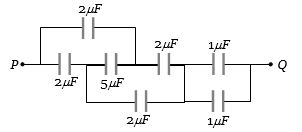
The effective capacitance between the points $P$ and $Q$ of the arrangement shown in the figure is......$\mu F$
On a foggy day, two drivers spot each other when $80\, m$ apart. They were travelling at $70\, km/h$ and $60\, km/h$. Both apply brakes simultaneously which retard the cars at the rate of $5\, ms^{-2}$. Which of the following statements is correct ?
Two resistors having equal resistances are joined in series and a current is passed through the combination. Neglect any variation in resistance as the temperature changes. In a given time interval
Given below are two statements: one is labelled a

Assertion $(A)$ and the other is labelled as Reason$(R)$

$Assertion$ $(A)$ : Work done by electric field on moving a positive charge on an equipotential surface is always zero.

$Reason$ $(R)$ : Electric lines of forces are always perpendicular to equipotential surfaces.

In the light of the above statements, choose the most appropriate answer from the options given below 

A solid body of constant heat capacity $1\,J /{ }^{\circ} C$ is being heated by keeping it in contact with reservoirs in two ways :

$(i)$ Sequentially keeping in contact with $2$ reservoirs such that each reservoir supplies same amount of heat.

$(ii)$ Sequentially keeping in contact with 8 reservoirs such that each reservoir supplies same amount of heat.

In both the cases body is brought from initial temperature $100^{\circ}\,C$ to final temperature $200^{\circ}\,C$. Entropy change of the body in the two cases respectively is :

If the capacitance of a nanocapacitor is measured in terms of a unit $u$ made by combining the electric charge $e,$ Bohr radius $a_0,$ Planck's constant $h$ and speed of light $c$ then
On increasing the length by $0.5\, mm$ in a steel wire of length $2\, m$ and area of cross-section $2\,m{m^2}$, the force required is $[Y$ for steel$ = 2.2 \times {10^{11}}\,N/{m^2}]$