MCQ
If ${\left( {\frac{{1 + i}}{{1 - i}}} \right)^x} = 1,$ then
  • $x = 4n$, where $n$ is any positive integer
  • B
    $x = 2n$, where $n$ is any positive integer
  • C
    $x = 4n + 1$, where $n$ is any positive integer
  • D
    $x = 2n + 1$, where $n$ is any positive integer

Answer

Correct option: A.
$x = 4n$, where $n$ is any positive integer
a
(a) ${\left( {\frac{{1 + i}}{{1 - i}}} \right)^x} = 1,$

==> ${\left( {\frac{{1 + {i^2} + 2i}}{{1 + 1}}} \right)^x} = 1\,\, \Rightarrow \,{i^x} = 1\,$
$\therefore x = 4n,\,n \in {I^ + }$.

Need a full question paper?

Generate a complete, print-ready paper with questions like this in minutes — across 16+ boards, with answer keys.

Start Generating Free

Similar questions

Let $\mathrm{X}$ be a random variable with distribution.

$\mathrm{x}$ $-2$ $-1$ $3$ $4$ $6$
$\mathrm{P}(\mathrm{X}=\mathrm{x})$ $\frac{1}{5}$ $\mathrm{a}$ $\frac{1}{3}$ $\frac{1}{5}$ $\mathrm{~b}$

If the mean of $X$ is $2.3$ and variance of $X$ is $\sigma^{2}$, then $100 \sigma^{2}$ is equal to :

If $f′ (0) = 0$ and $f(x)$ is a differentiable and increasing function,then $\lim\text{x}\rightarrow0 \ \frac{\text{x},\text{f(x)}^2}{\text{f(x)}}$:
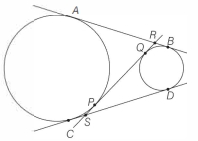
Suppose $S_1$ and $S_2$ are two unequal circles, $A B$ and $C D$ are the direct common tangents to these circles. A transverse common tangent $P Q$ cuts $A B$ in $R$ and $C D$ in $S$. If $A B=10$, then $R S$ is
If $\frac{{{{(p + i)}^2}}}{{2p - i}} = \mu + i\lambda ,$then ${\mu ^2} + {\lambda ^2}$ is equal to
If $z = \frac{{1 + i\sqrt 3 }}{{\sqrt 3 + i}},$ then${(\bar z)^{100}}$ lies in
Sets $A$ and $B$ have $3$ and $6$ elements respectively. What can be the minimum number of elements in $\ce{A ∪ B} ?$
The number of ways in which first, second and third prizes can be given to $5$ competitors is
Let $a, b, c, d$ and $p$ be any non zero distinct real numbers such that  $\left(a^{2}+b^{2}+c^{2}\right) p^{2}-2(a b+b c+ cd ) p +\left( b ^{2}+ c ^{2}+ d ^{2}\right)=0 .$ Then
$\mathop {\lim }\limits_{n \to \infty } \left( {\frac{{n + 1}}{{{n^2} + {1^2}}} + \frac{{n + 2}}{{{n^2} + {2^2}}} + \frac{{n + 3}}{{{n^2} + {3^2}}} + ....... + \frac{1}{n}} \right) = $
In how many ways $5$ speakers $S_1,S_2,S_3,S_4$ and $S_5$ can give speeches one after the other if $S_3$ wants to speak after $S_1$ & $S_2$