Question
If ${\left( {x - a} \right)^2} + {\left( {y - b} \right)^2} = {c^2}$ for some c > 0 prove that $\frac{{{{\left[ {1 + {{\left( {\frac{{dy}}{{dx}}} \right)}^2}} \right]}^{\frac{3}{2}}}}}{{\frac{{{d^2}y}}{{d{x^2}}}}}$ is a constant independent of a and b.

Answer

Given: ${\left( {x - a} \right)^2} + {\left( {y - b} \right)^2} = {c^2},$……….(i)

$\therefore 2\left( {x - a} \right) + 2\left( {y - b} \right)\frac{{dy}}{{dx}} = 0$

$\Rightarrow 2\left( {x - a} \right) = - 2\left( {y - b} \right)\frac{{dy}}{{dx}}$

$\Rightarrow \frac{{dy}}{{dx}} = - \left( {\frac{{x - a}}{{y - b}}} \right)$ ……….(ii)

Again $\frac{{{d^2}y}}{{d{x^2}}} = \frac{{ - \left[ {\left( {y - b} \right).1 - \left( {x - a} \right)\frac{{dy}}{{dx}}} \right]}}{{{{\left( {y - b} \right)}^2}}}$

$\Rightarrow \frac{{{d^2}y}}{{d{x^2}}} = \frac{{ - \left[ {\left( {y - b} \right).1 - \left( {x - a} \right)\left( {\frac{{ - \left( {x - a} \right)}}{{y - b}}} \right)} \right]}}{{{{\left( {y - b} \right)}^2}}}$ [From eq. (ii)

$\Rightarrow \frac{{{d^2}y}}{{d{x^2}}} = \frac{{ - \left[ {\left( {y - b} \right) + \left( {\frac{{{{\left( {x - a} \right)}^2}}}{{y - b}}} \right)} \right]}}{{{{\left( {y - b} \right)}^2}}}$

$= \frac{{ - \left[ {{{\left( {y - b} \right)}^2} + {{\left( {x - a} \right)}^2}} \right]}}{{{{\left( {y - b} \right)}^3}}}$

$= \frac{{ - {c^2}}}{{{{\left( {y - b} \right)}^3}}}$ ……….(iii) [using (i)]

Putting values of $\frac{{dy}}{{dx}}$ and $\frac{{{d^2}y}}{{d{x^2}}}$ in the given expression,

$\frac{{{{\left[ {1 + {{\left( {\frac{{dy}}{{dx}}} \right)}^2}} \right]}^{\frac{3}{2}}}}}{{\frac{{{d^2}y}}{{d{x^2}}}}}$

$ = \frac{{{{\left[ {1 + {{\frac{{\left( {x - a} \right)}}{{{{\left( {y - b} \right)}^2}}}}^2}} \right]}^{\frac{3}{2}}}}}{{\frac{{ - {c^2}}}{{{{\left( {y - b} \right)}^3}}}}}$

$= \frac{{{{\left[ {{{\left( {y - b} \right)}^2} + {{\left( {x - a} \right)}^2}} \right]}^{\frac{3}{2}}}}}{{{{\left( {y - b} \right)}^3}}} \times \frac{{{{\left( {y - b} \right)}^3}}}{{ - {c^2}}} = \frac{{{{\left( {{c^2}} \right)}^{\frac{3}{2}}}}}{{ - {c^2}}} = - c$

which is a constant and is independent of a and b.
Need a full question paper?

Generate a complete, print-ready paper with questions like this in minutes — across 16+ boards, with answer keys.

Start Generating Free

Similar questions

Evaluate the following integrals:
$\int\limits^{\frac{3}{2}}_0\big|\text{x}\sin\pi\text{x}\big|\text{dx}$
Find the points on the curve $x^2 + y^2 - 2x - 3 = 0$ at which the tangents are parallel to the x-axis.
Solve the following differential equation:
$\frac{\text{dy}}{\text{dx}}=\frac{\text{x}}{2\text{y}+\text{x}}$
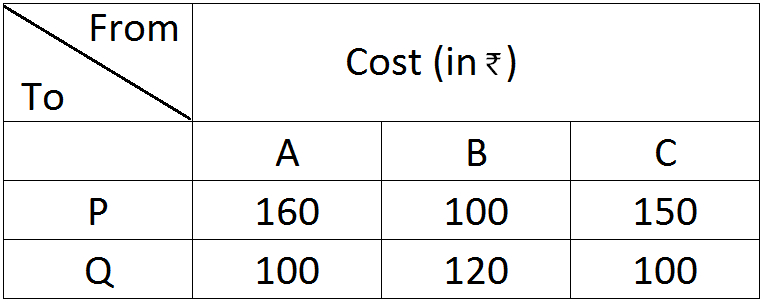
There are two factories located one at place P and the other at place Q. From these locations, a certain commodity is to be delivered to each of the three depots situated at A, B and C. The weekly requirements of the depots are respectively 5, 5 and 4 units of the commodity while the production capacity of the factories at P and Q are respectively 8 and 6 units. The cost of transportation per unit is given below:
How many units should be transported from each factory to each depot in order that the transportation cost is minimum. What will be the minimum transportation cost?
Solve the following systems of linear equations by cramer's rule:
9x + 5y = 10,
3x - 2y = 8
If $\vec{\text{a}}=\hat{\text{i}}+\hat{\text{j}}+\hat{\text{k}}$ and $=\vec{\text{b}}=\hat{\text{j}}-\hat{\text{k}},$ then find a vector $\vec{\text{c}}$ such that $\vec{\text{a}}\times\vec{\text{c}}=\vec{\text{b}}$ and $\vec{\text{a}}\cdot\vec{\text{c}}=3.$
Evaluate the following integrals:
$\int\text{e}^{2\text{x}}\cos(3\text{x}+4)\text{dx}$
Find the angle between the lines whose direction cosines are given by the equations $l + m + n = 0, l^2 + m^2- n^2 = 0.$
Show that the function $f: R \rightarrow\{x \in R:-1< x < 1\}$ defined by $f(x)=\frac{x}{1+|x|}, x \in R$ is one$-$one and onto function.
$\text{(x}^{2} + \text{y}^{2})\text{dy = xy dx. If y (1) = 1 and y (x}_{0}) = \text{e then find the value of x}_{0}.$