MCQ
If $\left|\begin{array}{cc}2 x & 5 \\ 8 & x\end{array}\right|=\left|\begin{array}{cc}6 & -2 \\ 7 & 3\end{array}\right|$, then find the value of $x$.
  • A
    $\pm 2$
  • B
    $\pm 3$
  • C
    $\pm 6$
  • D
    $\pm 4$

Answer

$
\begin{array}{l}
\text { (c) : }\left|\begin{array}{cc}
2 x & 5 \\
8 & x
\end{array}\right|=\left|\begin{array}{cc}
6 & -2 \\
7 & 3
\end{array}\right| \Rightarrow 2 x^2-40=18+14 \\
\Rightarrow x^2=36 \Rightarrow x= \pm 6
\end{array}
$

Need a full question paper?

Generate a complete, print-ready paper with questions like this in minutes — across 16+ boards, with answer keys.

Start Generating Free

Similar questions

Let $\overrightarrow{ a }=\alpha \hat{ i }+2 \hat{ j }-\hat{ k }$ and $\overrightarrow{ b }=-2 \hat{ i }+\alpha \hat{ j }+\hat{ k }$, where $\alpha \in R$. If the area of the parallelogram whose adjacent sides are represented by the vectors $\vec{a}$ and $\vec{b}$ is $\sqrt{15\left(\alpha^{2}+4\right)}$, then the value of $2|\vec{a}|^{2}+(\vec{a} \cdot \vec{b})|\vec{b}|^{2}$ is equal to
The function $f(x) = p\,[x + 1] + q[x - 1],$ where $[x]$is the greatest integer function is continuous at $x = 1$, if
If $A = \left[ {\begin{array}{*{20}{c}}1&0&0\\0&1&0\\a&b&{ - 1}\end{array}} \right]$, then  ${A^2} = $
The general solution of differention eqution of the ex dy + (yex + 2x)dx = 0 is:
  1.  xey + x2 = C
  2. xey + y2 = C
  3. yex + y2 = C
  4. yey + x2 = C
A number $x$ is chosen at random from the set $\{1, 2, 3, 4, .... , 100\}$ . Define the event: $A =$ the chosen number $x$ satisfies $\frac{{(x - 10)(x - 50)}}{{(x - 30)}} \ge 0.$ Then $P(A)$ is
Let $f (x) = a^x (a > 0)$ be written as $f( x) = f_1( x) + f_2( x)$ , where $f_1( x)$ is an even function and $f_2( x)$ is an odd function. Then $f_1( x + y) + f_1( x - y )$ equals
If  $2\int_0^1 {{{\tan }^{ - 1}}}\,xdx = \int_0^1 {{{\cot }^{ - 1}}}\,(1 - x + {x^2})dx,$ then $\int_0^1 {{{\tan }^{ - 1}}}\, (1 - x + {x^2})dx$  is equal to 
The lines $\frac{\text{x}}{1}=\frac{\text{y}}{2}=\frac{\text{z}}{3}$ and $\frac{\text{x}-1}{-2}=\frac{\text{y}-2}{-4}=\frac{\text{z}-3}{-6}$ are:
  1. Coinicident.
  2. Skew.
  3. Intersecting.
  4. Parallel.
The value of ${\cos ^{ - 1}}\left( {\cos \frac{{5\pi }}{3}} \right) + {\sin ^{ - 1}}\left( {\cos \frac{{5\pi }}{3}} \right)$ is
 $(i)$  $f (x)$ is continuous and defined for all real numbers

$(ii)$ $f '(-5) = 0 \,; \,f '(2)$ is not defined and $f '(4)  = 0$

$(iii)$ $(-5, 12)$ is a point which lies on the graph of $f (x)$

$(iv)$ $f ''(2)$ is undefined, but $f ''(x)$ is negative everywhere else.

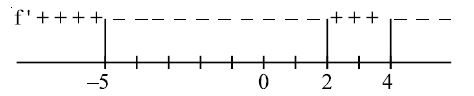
$(v)$ the signs of  $f '(x)$ is given below

Possible graph of $y = f (x)$ is