MCQ
If $\left|\begin{array}{ll}3 & 3 \\ x & 1\end{array}\right|=\left|\begin{array}{cc}-3 & x \\ 1 & 1\end{array}\right|$ then value of $x$ is :
  • A
    2
  • 3
  • C
    -3
  • D
    -2

Answer

Correct option: B.
3
(B)$\quad\left|\begin{array}{ll}3 & 3 \\ x & 1\end{array}\right|=\left|\begin{array}{cc}-3 & x \\ 1 & 1\end{array}\right|$
$
\begin{aligned}
\Rightarrow & & 3-3 x & =-3-x \\
\Rightarrow & & 3+3 & =3 x-x \\
\Rightarrow & & 6 & =2 x \Rightarrow x=3
\end{aligned}
$

Need a full question paper?

Generate a complete, print-ready paper with questions like this in minutes — across 16+ boards, with answer keys.

Start Generating Free

Similar questions

If $(x,\,\,y,\,\,z) \ne (0,\,\,0,\,\,0)$ and $(i + j + 3\,k)\,x + (3\,i - 3j + k)\,y$$ + ( - 4i + 5j)\,z = \lambda \,(xi + yj + zk),$ then the value of $\lambda $ will be
If ${e^y} + xy = e$, then the value of ${{{d^2}y} \over {d{x^2}}}$ for $x = 0$, is
The function $\text{f(x)}=\begin{cases}\frac{\sin3\text{x}}{\text{x}},&\text{x}\ne0\\\frac{\text{k}}{2},&\text{x}=0\end{cases}$ is continuous at x = 0, then k =
  1. 3
  2. 6
  3. 9
  4. 12
The vector $2\,i + a\,j + k$ is perpendicular to the vector $2\,i - j - k,$ if $a = $
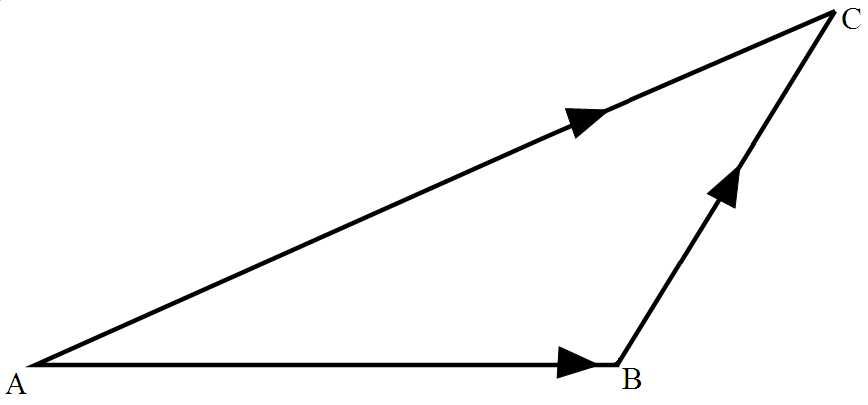
In figure, which of the following is not true?

  1. $​​​​​\overrightarrow{\text{AB}}+\overrightarrow{\text{BC}}+\overrightarrow{\text{CA}}=\vec0$

  2. $​​​​​\overrightarrow{\text{AB}}+\overrightarrow{\text{BC}}-\overrightarrow{\text{AC}}=\vec0$

  3. $​​​​​\overrightarrow{\text{AB}}+\overrightarrow{\text{BC}}-\overrightarrow{\text{CA}}=\vec0$

  4. $​​​​​\overrightarrow{\text{AB}}-\overrightarrow{\text{CB}}+\overrightarrow{\text{CA}}=\vec0$
If $\text{A} =\displaystyle \begin{bmatrix} -1 &\text{amp; } 0 &\text{amp; }0 \\ 0 &\text{amp; }\text{x} &\text{amp; } 0 \\ 0 &\text{amp; } 0 &\text{amp; }\text{m} \end{bmatrix}$is a scalar matrix then $\text{x}+\text{m}=$
  1. 0
  2. -1
  3. -2
  4. -3
In transportation models designed in linear programming, points of demand is classified as:
  1. Ordination
  2. Transportation
  3. Destinations
  4. Origins
If $\tan^{-1}(\text{x}-1)+\tan^{-1}\text{x}+\tan^{-1}(\text{x}+1)=\tan^{-1}3\text{x},$ then the values of x are:
  1. $\pm\frac{1}{2}$
  2. $0,\frac{1}{2}$
  3. $0,-\frac{1}{2}$
  4. $0,\pm\frac{1}{2}$
A function $f$ is defined as follows,

$f(x) =$ $\left\{ {\begin{array}{*{20}{c}}  {\sin \,x}&{if\,\,\,x\,\, \leqslant \,\,c} \\   {ax\, + \,b}&{if\,\,\,x\,\, > \,\,c} \end{array}} \right.$ where $c$ is a known quantity.

If $f$ is derivable at $x = c$ , then the values of $'a'$ $and$ $'b’$ are _____ $and$______ respectively

The value of $k$ for which the function $f\left( x \right) = \left\{ \begin{gathered} {\left( {\frac{4}{5}} \right)^{\frac{{\tan \,4x}}{{\tan \,5x}}}},\,\,\,\,0 < x < \frac{\pi }{2} \hfill \\  k + \frac{2}{5}\,\,\,,\,\,\,\,\,\,\,\,\,\,\,x = \frac{\pi }{2} \hfill \\ \end{gathered}  \right.$ is continuous at  $x\,= \frac{\pi}{2}$ is