MCQ
If momentum $(P),$ area $(A)$ and time $(T)$ are taken to be fundamental quantities, then energy has the dimensional formula:
  • A
    $(\text{P}^1\text{A}^{-1}\text{T}^1).$
  • B
    $(\text{P}^2\text{A}^{1}\text{T}^1).$
  • C
    $(\text{P}^1\text{A}^\frac{-1}{2}\text{T}^1).$
  • $(\text{P}^1\text{A}^\frac{1}{2}\text{T}^{-1}).$
Answer

Correct option: D.
$(\text{P}^1\text{A}^\frac{1}{2}\text{T}^{-1}).$
According to the problem, fundamental quantities are momentum $(p),$ area $(A)$ and time $(T)$ and we have to express energy in these fundamental quantities.
Let energy $E$,
$\text{E}\propto\text{p}^\text{a}\text{A}^\text{A}\text{T}^\text{c}\Rightarrow\text{E}=\text{kp}^\text{a}\text{A}^\text{A}\text{T}^\text{c}$
where, $k$ is dimensionless constant of proportionality.
Dimensional formula of energy, $[\text{E}]=[\text{ML}^2\text{T}^{-2}]$ and $[\text{p}]=[\text{MLT}^{-1}]$
$[\text{A}]=[\text{L}^2],\ [\text{T}]=[\text{T}]$ and $[\text{E}]=[\text{K}][\text{p}]^\text{a}[\text{A}]^\text{b}[\text{T}]^\text{c}$
Putting all the dimensions, we get
$\text{ML}^2\text{T}^2=[\text{MLT}^{-1}]^\text{a}[\text{L}^2]^\text{b}[\text{T}]^\text{c}$
$\text{M}^\text{a}\text{L}^{\text{a}+2\text{b}}\text{T}^{\text{-a}+\text{c}}$
According to the principle of homogeneity of dimensions, we get,
$\text{a}=1\ \ \ ...(\text{i)}$
$\text{a}+2\text{b}=2\ \ \ ...(\text{ii)}$
$-\text{a}+\text{c}=-2\ \ \ ...(\text{iii)}$
By solving these equations $(i), (ii)$ and $(iii),$ we get
$\text{a}=1,\ \text{b}=\frac{1}{2},\ \text{c}=-1$
Dimensional formula for $E$ is $[\text{p}^1\text{A}^\frac{1}{2}\text{t}^{-1}].$

Need a full question paper?

Generate a complete, print-ready paper with questions like this in minutes — across 16+ boards, with answer keys.

Start Generating Free

Similar questions

${T}_{0}$ is the time period of a simple pendulum at a place. If the length of the pendulum is reduced to $\frac{1}{16}$ times of its initial value, the modified time
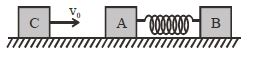
A block $C$ of mass $m$ is moving with velocity $v_0$ and collides elastically with block $A$ of mass $m$ which connected to another block $B$ of mass $2\,m$ through a spring of spring constant $k$. What is $k$ if $x_0$ is the compression of spring when velocity of $A$ and $B$ is same?
In an isothermal process on an ideal gas, the pressure increases by 0.5%. The volume decreases by about
Two balls $A$ and $B$ are thrown with same velocity $u$ from the top of a tower. Ball $A$ is thrown vertically upwards and the ball $B$ is thrown vertically downwards. If $t_A = 6\  s$ and $t_B = 2\ s$, then the height of the tower is ......... $m$
Two satellites of masses $m_1$ and $m_2$ $(m_1 > m_2)$ are revolving round the earth in circular orbits of radii $r_1$ and $r_2(r_1 > r_2)$ respectively. Which of the following statements is true regarding their speeds $v_1$ and $v_2$.
A drum of radius $R$ and mass $M$ rolls down without slipping along an inclined plane of angle. The frictional force:
A ball $'A'$ of mass $m$ falls to the surface of the earth from infinity. Another ball $'B'$ of mass $2m$ falls to the earth from the height equal to six times radius of the earth then ratio of velocities of $'A'$ and $'B'$ on reaching the earth is
The maximum horizontal range of a projectile is $400\;m$.The maximum height atteined by it?
Select the pair whose dimensions are same
The temperature of an ideal gas is reduced from  $927^\circ C$ to  $27^\circ C$. The $r.m.s.$ velocity of the molecules becomes