MCQ
If more air is pushed in a soap bubble, the pressure in it:
  • Decreases.
  • B
    Increases.
  • C
    Remains same.
  • D
    Becomes zero.

Answer

Correct option: A.
Decreases.
Excess pressure inside a bubble is given by $\text{P}= \frac{4\text{T}}{\text{r}}\cdot$
When air is pushed into the bubble, it grows in size. Therefore, its radius increases. An increase in size causes the pressure inside the soap bubble to decrease as pressure is inversely proportional to the radius.

Need a full question paper?

Generate a complete, print-ready paper with questions like this in minutes — across 16+ boards, with answer keys.
Start Generating Free

Similar questions

In case of a forced vibration, the resonance wave becomes very sharp when the:
At what temperature $r.m.s.$ speed of air molecules doubles of that at $N.T.P.$ is ...... $^oC$
A boy ties a stone of mass $100 \,g$ to the end of a $2$ $m$ long string and whirls it around in a horizontal plane. The string can withstand the maximum tension of $80 \,N$. If the maximum speed with which the stone can revolve is $\frac{ K }{\pi} rev$. / $min$. The value of $K$ is (Assume the string is massless and unstretchable)
A string is stretched between fixed points separated by $75.0\, cm$. It is observed to have resonant frequencies of $420\, Hz$ and $315\, Hz$. There are no other resonant frequencies between these two. Then, the lowest resonant frequency for this string is .... $Hz$
Quantities which remain constant in a collision:
A pulley of radius $1.5\,m$ is rotated about its axis by a force $F =\left(12 t -3 t ^{2}\right)\,N$ applied tangentially (while $t$ is measured in seconds). If moment of inertia of the pulley about its axis of rotation is $4.5\,kg\,m ^{2}$, the number of rotations made by the pulley before its direction of motion is reversed, will be $\frac{K}{\pi}$. The value of $K$ is $.....$
The $K.E.$ of a body can be increased maximum by doubling its:
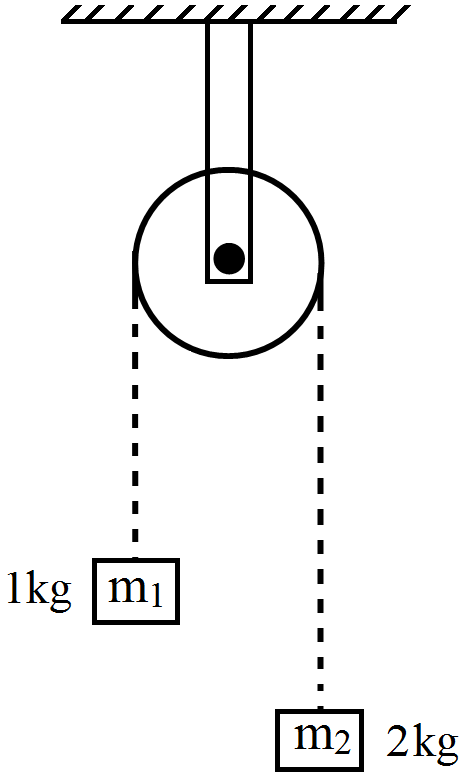
Two masses $m_1= 1\ kg$ and $m_2 = 2\ kg$ are connected by a light inextensible string and suspended by means of a weightless pulley as shown in figure,

Assuming that both the masses start from rest, the distance travelled by $2\ kg$ mass in $2s$ is:
Which of the following statements is correct ?
The equation of $SHM$ of a particle is given as

$2\,\frac{{{d^2}x}}{{d{t^2}}} + 32x = 0$

where $x$ is the displacement from the mean position of rest. The period of its oscillation (in seconds) is