If $n,\,e,\,\tau $ and $m$ respectively represent the density, charge relaxation time and mass of the electron, then the resistance of a wire of length $l$ and area of cross-section $A$ will be
Easy


Download our appand get started for free
Experience the future of education. Simply download our apps or reach out to us for more information. Let's shape the future of learning together!No signup needed.*
Similar Questions
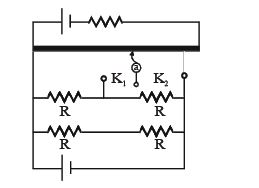
- 1In potentiometer experiment when $K_1$ is closed balance length is $100\,cm$. Then what will be balancing length when $K_2$ is closed ................ $\mathrm{cm}$View Solution
- 2By using only two resistance coils-singly, in series, or in parallel one should be able to obtain resistances of $3$, $4$, $12$ and $16\, ohms$. The separate resistances of the coil areView Solution
- 3Two wires of resistance $R_1$ and $R_2$ have temperature coefficient of resistance ${\alpha _1\,}{\rm{ and \,}}{\alpha _2}$, respectively. These are joined in series. The effective temperature coefficient of resistance isView Solution
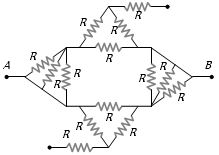
- 4Find equivalent resistance between $A$ and $B$View Solution
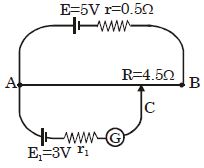
- 5In the given potentiometer circuit length of the wire $AB$ is $3\,m$ and resistance is $R = 4.5 \,\Omega.$ The length $AC$ for no deflection in galvanometer is ................ $\mathrm{m}$View Solution
- 6An electron revolves $6 × 10^{15}$ times/sec in circular loop. The current in the loop isView Solution
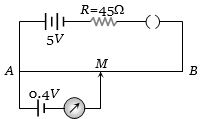
- 7In given figure, the potentiometer wire $AB$ has a resistance of $5$ $\Omega$ and length $10\, m$. The balancing length $AM$ for the $emf$ of $0.4\, V$ is ............... $m$View Solution
- 8Assertion : A larger dry cell has higher $emf$View Solution
Reason : The $emf$ of a dry cell is proportional to its size
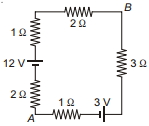
- 9Potential difference $V_B-V_A$ in the network shown is ............. $V$View Solution
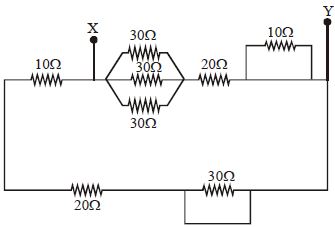
- 10Net resistance between $X$ and $Y$ is ............... $\Omega$View Solution