MCQ
If no external voltage is applied across $ P-N$  junction, there would be
  • A
    No electric field across the junction
  • An electric field pointing from $ N-$ type to $P-$ type side across the junction
  • C
    An electric field pointing from $P-$ type to $ N-$ type side across the junction
  • D
    A temporary electric field during formation of $P-N$  junction that would subsequently disappear
Answer

Correct option: B.
An electric field pointing from $ N-$ type to $P-$ type side across the junction
b
(b)Across the $P - N$ junction, a barrier potential is developed whose direction is from $N$ region to $P$ region.

Need a full question paper?

Generate a complete, print-ready paper with questions like this in minutes — across 16+ boards, with answer keys.

Start Generating Free

Similar questions

The energy of an electromagnetic wave contained in a small volume oscillates with
On passing electric current in two long straight conductors in mutually opposite directions, the magnetic force acting between them will be:
In electromagnetic induction, the induced charge in a coil is independent of
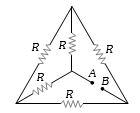
Each of the resistance in the network shown in fig. is equal to $R$. The resistance between the terminals $A$ and $B$ is
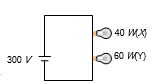
Two bulbs $X$ and $Y$ having same voltage rating and of power $40\, watt$ and $60\, watt$ respectively are connected in series across a potential difference of $300\, volt$, then
Two electrolytic cells containing CuSO$_4$ and AgNO$_3$ respectively are connected in series and a current is passed through them until 1 mg of copper is deposited in the first cell. The amount of silver deposited in the second cell during this time is approximately [Atomic weights of copper and silver are respectively 63.57 and 107.88]
Two identical glass $(\mu_g = 3/2)$ equiconvex lenses of focal length $f$ each are kept in contact. The space between the two lenses is filled with water $(\mu_w = 4/3).$ The focal length of the combination is
A symmetric double convex lens is cut in two equal parts by a plane perpendicular to the principal axis. If the power of the original lens was $4D$, the power of a cutlens will be:
The wavelength of $X-$rays is of the order of
A closely wound coil of $100$ turns and area of cross-section $1\;c{m^2}$ has a coefficient of self-induction $1 \,mH$. The magnetic induction in the centre of the core of the coil when a current of $2A$ flows in it, will be......$Wb{m^{ - 2}}$