Question
If non-parallel sides of a trapezium are equal, prove that it is cyclic.
Answer

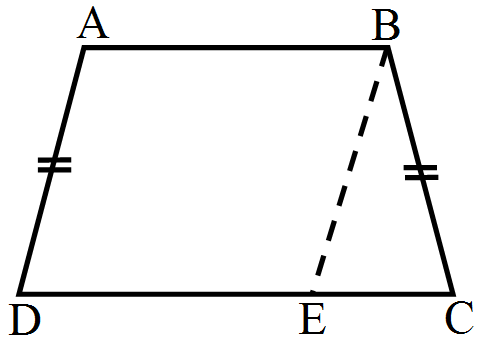
Given: ABCD is a trapezium whose non-parallel sides AD and BC are equal.

To prove: Trapezium ABCD is a cyclic
Join BE, where BE || AD.
Proof: Since, AB || DE and AD || BE
Since, the quadrilateral ABCD is a parallelogram,
$\therefore\angle\text{BAD}=\angle\text{BED}\ \ ...(\text{i})$ [opposite angles of a parallelogram are equal]
and AD = BE ...(ii) [opposite sides of a parallelogram are equal]
But, AD = BC [given] ...(iii)
From Eqs. (ii) and (iii), BC = BE
$\Rightarrow\angle\text{BEC}=\angle\text{BCE}\ \ ...\text{(iv)}$ [angle opposite to equal sides are equal]
Also, $\angle\text{BEC}+\angle\text{BED}=180^\circ$ [linear pair axiom]
$\therefore\angle\text{BCE}+\angle\text{BAD}=180^\circ$ [from Eqs. (i) and (iv)]
If sum of opposite angles of a quadrilateral is 180°, then quadrilateral is cyclic.
Hence, trapezium ABCD is a cyclic.
Hence proved.

Need a full question paper?

Generate a complete, print-ready paper with questions like this in minutes — across 16+ boards, with answer keys.
Start Generating Free

Similar questions

ABCD is a parallelogram; E and f are the mid-points of AB and CD respectively. GH is any line intersecting AD, EF and BC at G, P and H respectively. Prove that GP = PH.
Two circles with centres O and O′ intersect at two points A and B. A line PQ is drawn parallel to OO′ through A(or B) intersecting the circles at P and Q. Prove that PQ = 2OO′.
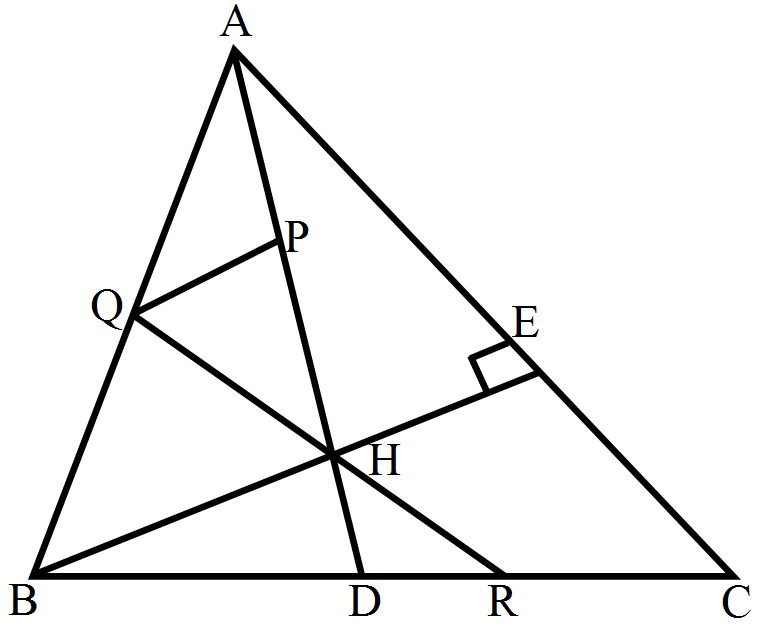
In Fig. $\text{BE}\bot\text{AC}$ AD is any line from A to BC intersecting BE in H. P, Q and R are respectively the mid-points of AH, AB and BC. prove that $\angle\text{PQR}=90^\circ.$

In a $\triangle\text{ABC},$ it is given that $\angle\text{A}:\angle\text{B}:\angle\text{C}=3:2:1$ and $\text{CD}\perp\text{AC}.$ Find $\angle\text{ECD}.$

If ABC and BDE are two equilateral triangles such that D is the mid-point of BC, then find $\text{ar}(\triangle\text{ABC}) : \text{ar}(\triangle\text{BDE}).$
Factorize:
$\Big(\text{x}^2+\frac{1}{\text{x}^2}\Big)-4\Big(\text{x}+\frac{1}{\text{x}}\Big)+6$
Five coins were simultaneously tossed 1000 times and at each, toss the number of heads was observed. The number of tosses during which 0, 1, 2, 3, 4 and 5 heads were obtained are shown in the table below. Find the mean number of heads per toss.
No. of heads per toss
No. of tosses
0
38
1
144
2
342
3
287
4
164
5
25
Total
1000
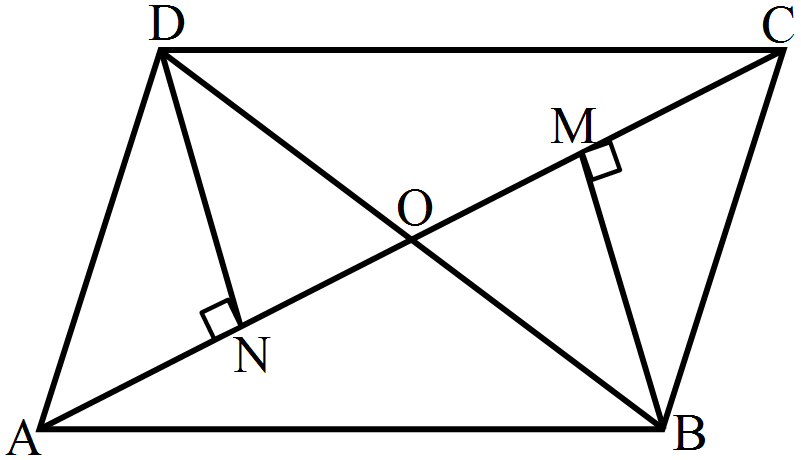
In the adjoining figure, $\text{BM}\perp\text{AC}$ and $\text{DN}\perp\text{AC}.$ If BM = DN, prove that AC bisects BD.
In square ABCD, P and Q are mid-point of AB and CD respectively. If AB = 8cm and PQand BD intersect at O, then find area of $(\triangle\text{OPB}).$