Question
If ${}^n{P_4}\;:\;{}^n{P_5} = 1:2$, then $n = $

Answer

c
(c) $\frac{{n\;!}}{{(n - 4)\;!}} \times \frac{{(n - 5)\;!}}{{n\;!}} = \frac{1}{2}$

$\Rightarrow n - 4 = 2 $

$\Rightarrow n = 6$.

Need a full question paper?

Generate a complete, print-ready paper with questions like this in minutes — across 16+ boards, with answer keys.
Start Generating Free

Similar questions

Let $B _{i}(i=1,2,3)$ be three independent events in a sample space. The probability that only $B _{1}$ occur is $\alpha,$ only $B _{2}$ occurs is $\beta$ and only $B _{3}$ occurs is $\gamma$. Let $p$ be the probability that none of the events $B _{i}$ occurs and these $4$ probabilities satisfy the equations $(\alpha-2 \beta) p =\alpha \beta$ and $(\beta-3 \gamma) p =2 \beta \gamma$ (All the probabilities are assumed to lie in the interval $(0,1))$. Then $\frac{ P \left( B _{1}\right)}{ P \left( B _{3}\right)}$ is equal to ..........
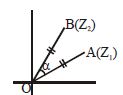
Let $z_1$, $z_2$ are the two complex number and roots of the equation $z^2 + az + b = 0$ and $O$ is the origin, such that $OA = OB$ and ${a^2} = \lambda b{\ \cos ^2}\ \frac{\alpha }{2}$, then $\lambda$ is equal to
The number of points, where the curve $y=x^5-20 x^3+50 x+2$ crosses the $x$-axis, is $............$.
How many words can be made from the letters of the word $BHARAT$ in which $ B $ and $H$ never come together
If $x = \sqrt[3]{{(\sqrt 2 + 1)}} - \sqrt[3]{{(\sqrt 2 - 1)}}$, then ${x^3} + 3x = $
The sum $\sum\limits_{k=1}^{20}(1+2+3+\ldots+k)$ is
A $G.P.$ consists of an even number of terms. If the sum of all the terms is $5$ times the sum of the terms occupying odd places, then the common ratio will be equal to
If $\int\left( e ^{2 x }+2 e ^{ x }- e ^{- x }-1\right) e ^{\left( e ^{ x }+ e ^{- x }\right)} d x$ $=g(x) e^{\left(e^{x}+e^{-x}\right)}+c,$ where $c$ is a constant of integration, then $g (0)$ is equal to
If the system of equations $2 x+7 y+\lambda z=3 , 3 x+2 y+5 z=4 , x+\mu y+32 z=-1$ has infinitely many solutions, then $(\lambda-\mu)$ is equal to $....... $ :
If two tangents drawn from a point $(\alpha, \beta)$ lying on the ellipse $25 x^{2}+4 y^{2}=1$ to the parabola $y^{2}=4 x$ are such that the slope of one tangent is four times the other, then the value of $(10 \alpha+5)^{2}+\left(16 \beta^{2}+50\right)^{2}$ equals