MCQ
If $\oint_s \vec{E} \cdot \overrightarrow{d S}=0$ over a surface, then:
  • A
    the electric field inside the surface is necessarily uniform.
  • the number of flux lines entering the surface must be equal to the number of flux lines leaving it.
  • C
    the magnitude of electric field on the surface is constant.
  • D
    all the charges must necessarily be inside the surface.
Answer

Correct option: B.
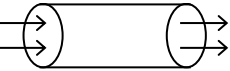
the number of flux lines entering the surface must be equal to the number of flux lines leaving it.
b
$\phi_{\text {closed }}=0$

$\text { So } \phi_{\text {in }}=\phi_{\text {out }}$

Number of field lines entering is equal number of field lines leaving.

Need a full question paper?

Generate a complete, print-ready paper with questions like this in minutes — across 16+ boards, with answer keys.

Start Generating Free

Similar questions

A body of mass $1\, kg$ starts moving from rest at $t = 0$, in $a$ circular path of radius $8 \,m$. Its kinetic energy varies as a function of time as : $K.E. = 2t^2$ Joules, where $t$ is in seconds. Then
A small steel sphere of mass $m$ is falling vertically through a viscous liquid with a constant speed $v$ . Which row in the table correctly describes the changes with time in the kinetic energy and gravitational potential energy of the sphere?

Kinetic Energy || Gravitational Potential Energy


The ratio of the speed of sound in nitrogen gas to that in helium gas, at $300 K$ is
The figure shows a conducting loop $ABCDA$ placed in a uniform magnetic field perpendicular to its plane. The part $ABC$ is the $(3/4)^{th}$ portion of the square of side length $l$ . The part $ADC$ is a circular arc of radius $R$ . The points $A$ and $C$ are connected to a battery which supply a current $I$ to the circuit. The magnetic force on the loop due to the field $B$ is
In Young's double slit experiment using sodium light ( $\lambda$$= 5898 Å$), $92$ fringes are seen. If given colour ($\lambda = 5461 Å$) is used, how many fringes will be seen
The mass density of a spherical body is given by $\rho \left( r \right) = \frac{k}{r}$ for $r \leq R\,\,$ and $\rho \left( r \right) = 0\,$ for $r > R$ , where $r$ is the distance from the centre. The correct graph that describes qualitatively the acceleration, $a$, of a test particle as a function of $r$ is
The minimum deviation produced by a hollow prism filled with a certain liquid is found to be $30^o $. The light ray is also found to be refracted at angle of $30^o $. The refractive index of the liquid is
A particle of mass $m$ moves in a circular orbit under the central potential field, $U ( r )=\frac{- C }{ r }$, where $C$ is a positive constant

The correct radius - velocity graph of the particle's motion is:

If the diameter of a capillary tube is doubled, then the height of the liquid that will rise is
A charge of $Q$ coulomb is placed on a solid piece of metal of irregular shape. The charge will distribute itself