MCQ
If $|\,\vec A + \vec B\,|\, = \,|\,\vec A\,| + |\,\vec B\,|$, then angle between $\vec A$ and $\vec B$ will be ....... $^o$
  • A
    $90$
  • B
    $120$
  • $0$
  • D
    $60$

Answer

Correct option: C.
$0$
c
(c) Resultant of two vectors $\overrightarrow A $ and $\overrightarrow B $ can be given by

$\overrightarrow R = \overrightarrow A + \overrightarrow B $

$|\overrightarrow R |\, = \,|\overrightarrow A + \overrightarrow B |\, = \sqrt {{A^2} + {B^2} + 2AB\cos \theta } $

If $\theta = 0^\circ $ then $|\overrightarrow R |\, = A + B$$ = \,|\overrightarrow A | + |\overrightarrow B |$

Need a full question paper?

Generate a complete, print-ready paper with questions like this in minutes — across 16+ boards, with answer keys.
Start Generating Free

Similar questions

A particle of mass $1\, {kg}$ is hanging from a spring of force constant $100\, {Nm}^{-1 .}$ The mass is pulled slightly downward and released so that it executes free simple harmonic motion with time period ${T}$. The time when the kinetic energy and potential energy of the system will become equal, is $\frac{{T}}{{x}}$. The value of ${x}$ is ..... .
The specific heat of a gas:
If the ratio of same thickness's wire densities is 1 : 2. If we keep same mass then ratio of same length frequency will be :
A body moves in a circular orbit of radius $R$ under the action of a central force. Potential due to the central force is given by $V(r)=k r$ ( $k$ is a positive constant). Period of revolution of the body is proportional to
A rigid bar of mass $15\,kg$ is supported symmetrically by three wire each of $2 \,m$ long. These at each end are of copper and middle one is of steel. Young's modulus of elasticity for copper and steel are $110 \times 10^9 \,N / m ^2$ and $190 \times 10^9 \,N / m ^2$ respectively. If each wire is to have same tension, ratio of their diameters will be ............
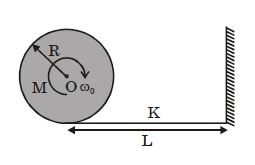
A uniform solid cylinder of mass $M$ and radius $R$ can freely rotate around its axis $O$ . There is a elastic string of relaxed length $L$ and stiffness $K$ attached to the cylinder and a static wall. Initially, the string is relaxed. As the cylinder starts rotating, the string will wind the cylinder. The surface of cylinder is very rough, so that the string does not slip on the cylinder’s surface. The minimum initial angular speed of the cylinder, ${\omega _0}$ , so that it can rotate to angle $2\pi $ is (Assume Hooke’s law to be valid.)
The Young's modulus of a wire of length $L$ and radius $r$ is $Y$ $N/m^2$. If the length and radius are reduced to $L/2$ and $r/2,$ then its Young's modulus will be
Out of the following which quantity does not depend on path
Which of the following is incorrect regarding the first law of thermodynamics
Two objects of mass $10\,kg$ and $20\,kg$ respectively are connected to the two ends of a rigid rod of length $10\,m$ with negligible mass. The distance of the center of mass of the system from the $10\,kg$ mass is :