MCQ
If $|\vec A \times \vec B| = \sqrt 3 \vec A.\vec B,$ then the value of$|\vec A + \vec B|$ is
  • A
    ${\left( {{A^2} + {B^2} + \frac{{AB}}{{\sqrt 3 }}} \right)^{1/2}}$
  • B
    $A + B$
  • C
    ${({A^2} + {B^2} + \sqrt 3 AB)^{1/2}}$
  • ${({A^2} + {B^2} + AB)^{1/2}}$

Answer

Correct option: D.
${({A^2} + {B^2} + AB)^{1/2}}$
d
(d) $|\,\overrightarrow A \times \overrightarrow B |\, = \sqrt 3 (\overrightarrow A .\overrightarrow B )$

$AB\sin \theta = \sqrt 3 AB\cos \theta $$ \Rightarrow $$\tan \theta = \sqrt 3 $ $⇒$ $\theta = 60^\circ $

Now $|\overrightarrow R |\, = \,|\overrightarrow A + \overrightarrow B |\, = \sqrt {{A^2} + {B^2} + 2AB\cos \theta } $

$ = \sqrt {{A^2} + {B^2} + 2AB\left( {\frac{1}{2}} \right)} $

$ = {({A^2} + {B^2} + AB)^{1/2}}$

Need a full question paper?

Generate a complete, print-ready paper with questions like this in minutes — across 16+ boards, with answer keys.

Start Generating Free

Similar questions

Two charged spheres separated at a distance $d$ exert a force $F$ on each other. If they are immersed in a liquid of dielectric constant $2$, then what is the force (if all conditions are same)
$1$ mole of gas occupies a volume of $100\, ml$ at $50\, mm$ pressure. What is the volume occupied by two moles of gas at $100\, mm$ pressure and at same temperature ..... $ml$
Measure of two quantities along with the precision of respective measuring instrument  $A = 2.5\,m{s^{ - 1}} \pm 0.5\,m{s^{ - 1}}$, $B = 0.10\,s \pm 0.01\,s$ The value of $AB$ will be
Four electrons, each of mass $m_{e}$ are in a one dimensional box of size $L$. Assume that, the electrons are non-interacting, obey the Pauli exclusion principle and are described by standing de Broglie waves confined within the box. Define $\alpha=h^{2} / 8 m_{e} L^{2}$ and $U_{0}$ to be the ground state energy. Then,
The coefficient of friction $\mu $ and the angle of friction $\lambda $ are related as
The mass of a nucleus ${ }_Z^A X$ is less that the sum of the masses of $(A-Z)$ number of neutrons and $Z$ number of protons in the nucleus. The energy equivalent to the corresponding mass difference is known as the binding energy of the nucleus. A heavy nucleus of mass $M$ can break into two light nuclei of masses $m_1$ and $m_2$ only if $\left(m_1+m_2\right)M^{\prime}$. The masses of some neutral atoms are given in the table below:

${ }_1^1 H$  $1.007825 u$ ${ }_2^1 H$ $2.014102 u$ ${ }_3^1 H$ $3.016050 u$ ${ }_2^4 He$ $4.002603 u$
${ }_3^6 Li$ $6.015123 u$ ${ }_7^3 Li$ $7.016004 u$ ${ }_70^30 Zn$ $69.925325 u$ ${ }_{34}^{82} Se$ $81.916709 u$
${ }_{64}^{152} Gd$ $151.919803 u$ ${ }_{206}^{82} Gd$ $205.974455 u$ ${ }_{209}^{83} Bi$ $208.980388 u$ ${ }_{84}^{210} Po$ $209.982876 u$

$1.$ The correct statement is:

$(A)$ The nucleus ${ }_3^6 Li$ can emit an alpha particle

$(B)$ The nucleus ${ }_{84}^{210} P_0$ can emit a proton

$(C)$ Deuteron and alpha particle can undergo complete fusion.

$(D)$ The nuclei ${ }_{30}^{70} Zn$ and ${ }_{34}^{82} Se$ can undergo complete fusion.

$2.$ The kinetic energy (in $keV$ ) of the alpha particle, when the nucleus ${ }_{84}^{210} P _0$ at rest undergoes alpha decay, is:

$(A)$ $5319$ $(B)$ $5422$ $(C)$ $5707$ $(D)$ $5818$

Give the answer question $1$ and $2.$
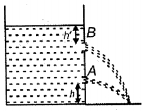
A tank is filled with water and two holes $A$ and $B$ are made in it. For getting same range, ratio of $h^{\prime} T h$ is ..........
The volume of air increases by $5\%$ in its adiabatic expansion. The percentage decrease in its pressure will be ...... $\%$
The binding energy per nucleon of ${O^{16}}$ is $7.97 \,MeV$ and that of ${O^{17}}$ is $7.75\, MeV$. The energy (in $MeV$) required to remove a neutron from ${O^{17}}$ is
A source of sound gives five beats per second when sounded with another source of frequency $100\,{s^{ - 1}}$. The second harmonic of the source together with a source of frequency $205\,{s^{ - 1}}$ gives five beats per second. What is the frequency of the source .... ${s^{ - 1}}$