MCQ
If $|x - 2| + |x - 3| = 7$, then $x =$
  • A
    $6$
  • B
    $-1$
  • $6$  or $-1$
  • D
    None of these

Answer

Correct option: C.
$6$  or $-1$
c
(c) Here $x = 2$ and $3$ are the critical points.

When $x < 2,|x - 2| = - (x - 2),|x - 3| = - (x - 3)$

$\therefore $ The given equation reduces to $2 - x + 3 - x = 7$

==> $x = - 1 < 2$

$\therefore $ $x = - 1$ is a solution.

When $2 \le x < 3,\,\,|x - 2| = x - 2,|x - 3| = - (x - 3)$

$\therefore $ The equation reduces to $x - 2 + 3 - x = 7$==> $1=7$

$\therefore $ No solution in this case.

When $x \ge 3$, the equation reduces to

$x - 2 + x - 3 = 7$ ==> $x = 6 > 3$

Hence we get, $x = 6$or $-1$

Trick : By inspection, we have that both the values $x = 6, - 1$ satisfy the given equation.

Need a full question paper?

Generate a complete, print-ready paper with questions like this in minutes — across 16+ boards, with answer keys.

Start Generating Free

Similar questions

If the line $y = \sqrt 3x$ cuts the curve $x^3 + 3y^2 + 4x + 5y - 1 = 0$ at the points $A, B, C$ then $OA \cdot OB \cdot OC$ is
If the tangent at a point on the ellipse $\frac{{{x^2}}}{{27}} + \frac{{{y^2}}}{3} = 1$ meets the coordinate axes at $A$ and $B,$  and  $O$  is the origin, then the minimum area (in sq. units) of the triangle $OAB$  is
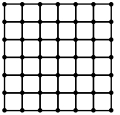
Consider the $6 \times 6$ square in the figure. Let $A_1, \mathrm{~A}_2, \ldots, A_{49}$ be the points of intersections (dots in the picture) in some order. We say that $A_i$ and $A_j$ are friends if they are adjacent along a row or along a column. Assume that each point $A_i$ has an equal chance of being chosen.

(image)

($1$) Let $p_i$ be the probability that a randomly chosen point has $i$ many friends, $i=0,1,2,3,4$. Let $X$ be a random variable such that for $i=0,1,2,3,4$, the probability $P(X=i)=p_i$. Then the value of $7 E(X)$ is

($2$) Two distinct points are chosen randomly out of the points $A_1, A_2, \ldots, A_{4 g}$. Let $p$ be the probability that they are friends. Then the value of $7 p$ is
$\int {\left( {\sin x\cos x\cos 2x\cos 4x\cos 8x} \right)dx}$ equal
There were two women participating in a chess tournament. Every participant played two games with the other participants. The number of games that the men played between themselves proved to exceed by $66$ the number of games that the men played with the women. The number of participants is
If the third term of a $G.P.$ is $4$ then the product of its first $5$ terms is
The number of real values $\lambda$, such that the system of linear equations $2 x-3 y+5 z=9$  ;  $x+3 y-z=-18$    ; $3 x-y+\left(\lambda^{2}-1 \lambda \mid\right) z=16$ has no solution, is :-
The value of the limit $\mathop {\lim }\limits_{x \to 0} \frac{{{e^x} - {e^{ - x}} - 2x}}{{x - \sin \,x}}$ is 
Let $a_1,a_2,a_3,....,a_{10}$ be in $G.P.$ with $a_i > 0$ for $i = 1, 2,....,10$ and $S$ be the set of pairs $(r,k), r, k \in N$ (the set of natural numbers) for which

$\left| {\begin{array}{*{20}{c}}
  {{{\log }_e}\,a_1^ra_2^k}&{{{\log }_e}\,a_2^ra_3^k}&{{{\log }_e}\,a_3^ra_4^k} \\
  {{{\log }_e}\,a_4^ra_5^k}&{{{\log }_e}\,a_5^ra_6^k}&{{{\log }_e}\,a_6^ra_7^k} \\ 
  {{{\log }_e}\,a_7^ra_8^k}&{{{\log }_e}\,a_8^ra_9^k}&{{{\log }_e}\,a_9^ra_{10}^k} 
\end{array}} \right| = 0$

Then the number of elements in $S$, is

The ends of the base of an isosceles triangle are at $(2a,\;0)$ and $(0,\;a).$ The equation of one side is $x=2a$ The equation of the other side is