MCQ
If $|z - 25i| \le 15$, then $|\max .amp(z) - \min .amp(z)| = $
  • A
    ${\cos ^{ - 1}}\left( {\frac{3}{5}} \right)$
  • $\pi - 2{\cos ^{ - 1}}\left( {\frac{3}{5}} \right)$
  • C
    $\frac{\pi }{2} + {\cos ^{ - 1}}\left( {\frac{3}{5}} \right)$
  • D
    ${\sin ^{ - 1}}\left( {\frac{3}{5}} \right) - {\cos ^{ - 1}}\left( {\frac{3}{5}} \right)$

Answer

Correct option: B.
$\pi - 2{\cos ^{ - 1}}\left( {\frac{3}{5}} \right)$
b
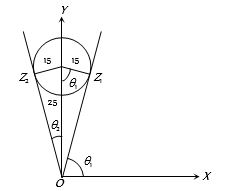
(b)We have
$max\ amp(z)=amp$$({z_2}),$ $min\ amp (z)=amp$$({z_1})$
Now $amp({z_1}) = {\theta _1} = {\cos ^{ - 1}}\left( {\frac{{15}}{{25}}} \right) = {\cos ^{ - 1}}\left( {\frac{3}{5}} \right)$
$amp({z_2}) = \frac{\pi }{2} + {\theta _2} = \frac{\pi }{2} + {\sin ^{ - 1}}\left( {\frac{{15}}{{25}}} \right) = \frac{\pi }{2} + {\sin ^{ - 1}}\left( {\frac{3}{5}} \right)$
$|\max \,\,amp(z) - \min \,\,amp(z)|$
$ = \left| {\frac{\pi }{2} + {{\sin }^{ - 1}}\frac{3}{5} - {{\cos }^{ - 1}}\frac{3}{5}} \right|$
$ = \left| {\frac{\pi }{2} + \frac{\pi }{2} - {{\cos }^{ - 1}}\frac{3}{5} - {{\cos }^{ - 1}}\frac{3}{5}} \right| = \pi - 2{\cos ^{ - 1}}\frac{3}{5}$

Need a full question paper?

Generate a complete, print-ready paper with questions like this in minutes — across 16+ boards, with answer keys.

Start Generating Free

Similar questions

If ${ }^{1} \mathrm{P}_{1}+2 \cdot{ }^{2} \mathrm{P}_{2}+3 \cdot{ }^{3} \mathrm{P}_{3}+\ldots+15 \cdot{ }^{15} \mathrm{P}_{15}={ }^{\mathrm{q}} \mathrm{P}_{\mathrm{r}}-\mathrm{s}, 0 \leq \mathrm{s} \leq 1$ then ${ }^{\mathrm{q}+\mathrm{s}} \mathrm{C}_{\mathrm{r}-\mathrm{s}}$ is equal to .... .
Let a triangle be bounded by the lines $L _{1}: 2 x +5 y =10$; $L _{2}:-4 x +3 y =12$ and the line $L _{3}$, which passes through the point $P (2,3)$, intersect $L _{2}$ at $A$ and $L _{1}$ at $B$. If the point $P$ divides the line-segment $A B$, internally in the ratio $1: 3$, then the area of the triangle is equal to
The area of the triangle whose vertices are complex numbers $z,\, iz,\, z + iz$ in the Argand diagram is
Let $\Omega$ be the sample space and $A \subseteq \Omega$ be an event. Given below are two statements :

$(S1)$ : If $P ( A )=0$, then $A =\phi$

$( S 2)$ : If $P ( A )=$, then $A =\Omega$

Then

The radical centre of the circles ${x^2} + {y^2} - 16x + 60 = 0,\,{x^2} + {y^2} - 12x + 27 = 0,$ ${x^2} + {y^2} - 12y + 8 = 0$ is
Let $\frac{x^2}{a^2}+\frac{y^2}{b^2}=1, a>b$ be an ellipse with foci $F_1$ and $F_2$. Let $AO$ be its semi-minor axis, where $O$ is the centre of the ellipse. The lines $A F_1$ and $A F_2$, when extended, cut the ellipse again at points $B$ and $C$ respectively. Suppose that the $\triangle A B C$ is equilateral. Then, the eccentricity of the ellipse is
If the sum of the square of the roots of the equation ${x^2} - \left( {\sin \,\alpha  - 2} \right)\,x - \left( {1 + \sin \,\alpha } \right) = 0$ is least, then $\alpha $ is
Let the hyperbola $H : \frac{ x ^{2}}{ a ^{2}}- y ^{2}=1$ and the ellipse $E: 3 x^{2}+4 y^{2}=12$ be such that the length of latus rectum of $H$ is equal to the length of latus rectum of $E$. If $e_{ H }$ and $e_{ E }$ are the eccentricities of $H$ and $E$ respectively, then the value of $12\left( e _{ H }^{2}+ e _{ E }^{2}\right)$ is equal to
The lines $2x - 3y = 5$ and $3x - 4y = 7$ are the diameters of a circle of area $154$ square units. The equation of the circle is
A point $\mathrm{z}$ moves in the complex plane such that $\arg \left(\frac{\mathrm{z}-2}{\mathrm{z}+2}\right)=\frac{\pi}{4}$, then the minimum value of $|z-9 \sqrt{2}-2 i|^{2}$ is equal to ..... .