Question
If $P ( A )=\frac{1}{2}, P ( B )=0$ then $P ( A \mid B )$ is _____________ .

Answer

not defined.

Need a full question paper?

Generate a complete, print-ready paper with questions like this in minutes — across 16+ boards, with answer keys.
Start Generating Free

Similar questions

If $A =\left[\begin{array}{cc}1 & 3 \\ -2 & 5\end{array}\right]$ and $B =\left[\begin{array}{ll}2 & 4 \\ 3 & 2\end{array}\right]$, then $A - B =$ ________
Fill in the blanks:
The least value of the function $\text{f(x)}=\text{ax}+\frac{\text{b}}{\text{a}}(\text{a}>0,\text{b}>0,\text{x}>0)$ is ______.
If the angle between two non-zero vectors $\vec{a}$ and $\vec{b}$ is $\theta$, then $\cos \theta=$ ___________ .
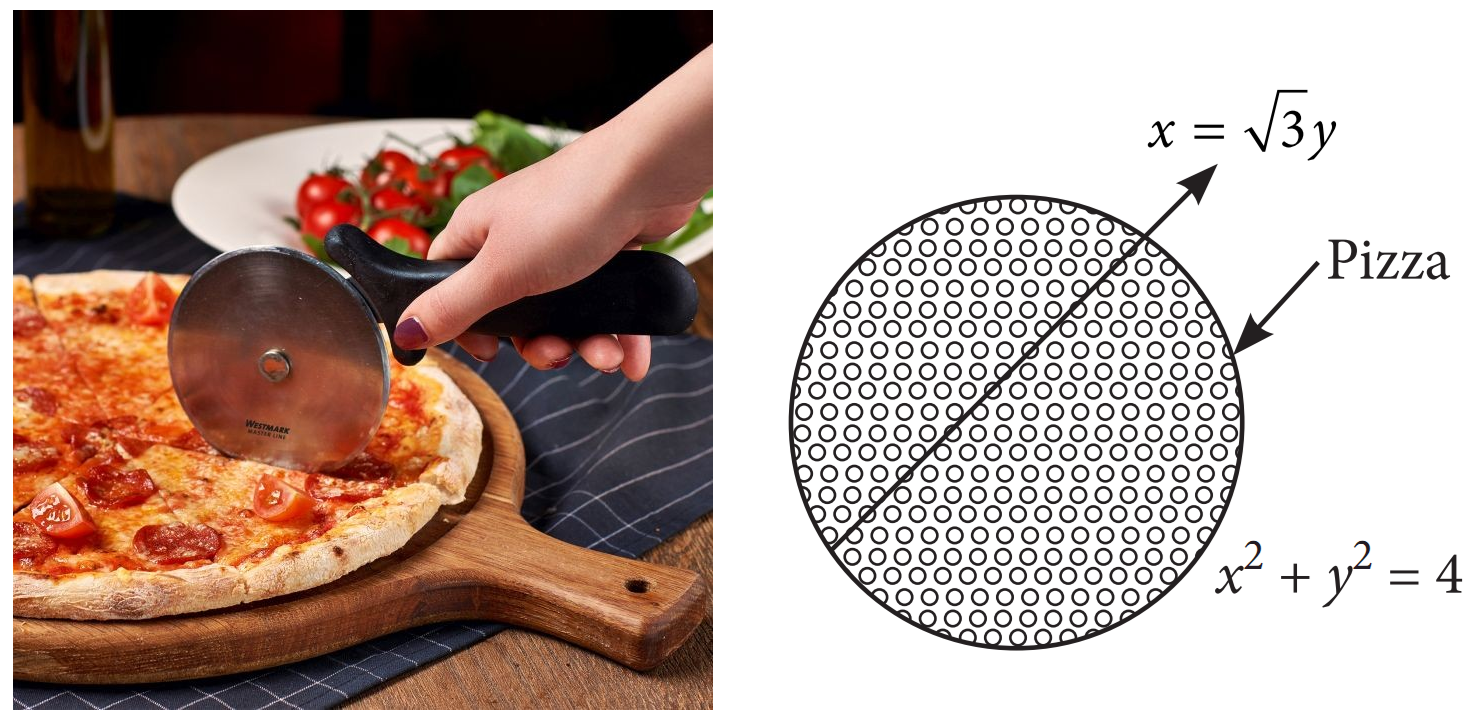
A child cut a pizza with a knife. Pizza is circular in shape which is represented by $x^2+y^2=4$ and sharp edge of knife represents a straight line given by $\text{x}=\sqrt{3\text{y}}$ Based on the above information, answer the following questions.
  1. The point(s) of intersection of the edge of knife (line) and pizza shown in the figure is (are).
  1. $(1, \sqrt{3}),(-1,-\sqrt{3})$
  2. $(\sqrt{3},1),(-\sqrt{3,}-1)$
  3. $(\sqrt{2,}0),(0,\sqrt{3})$
  4. $(-\sqrt{3,}),(1,-\sqrt{3})$
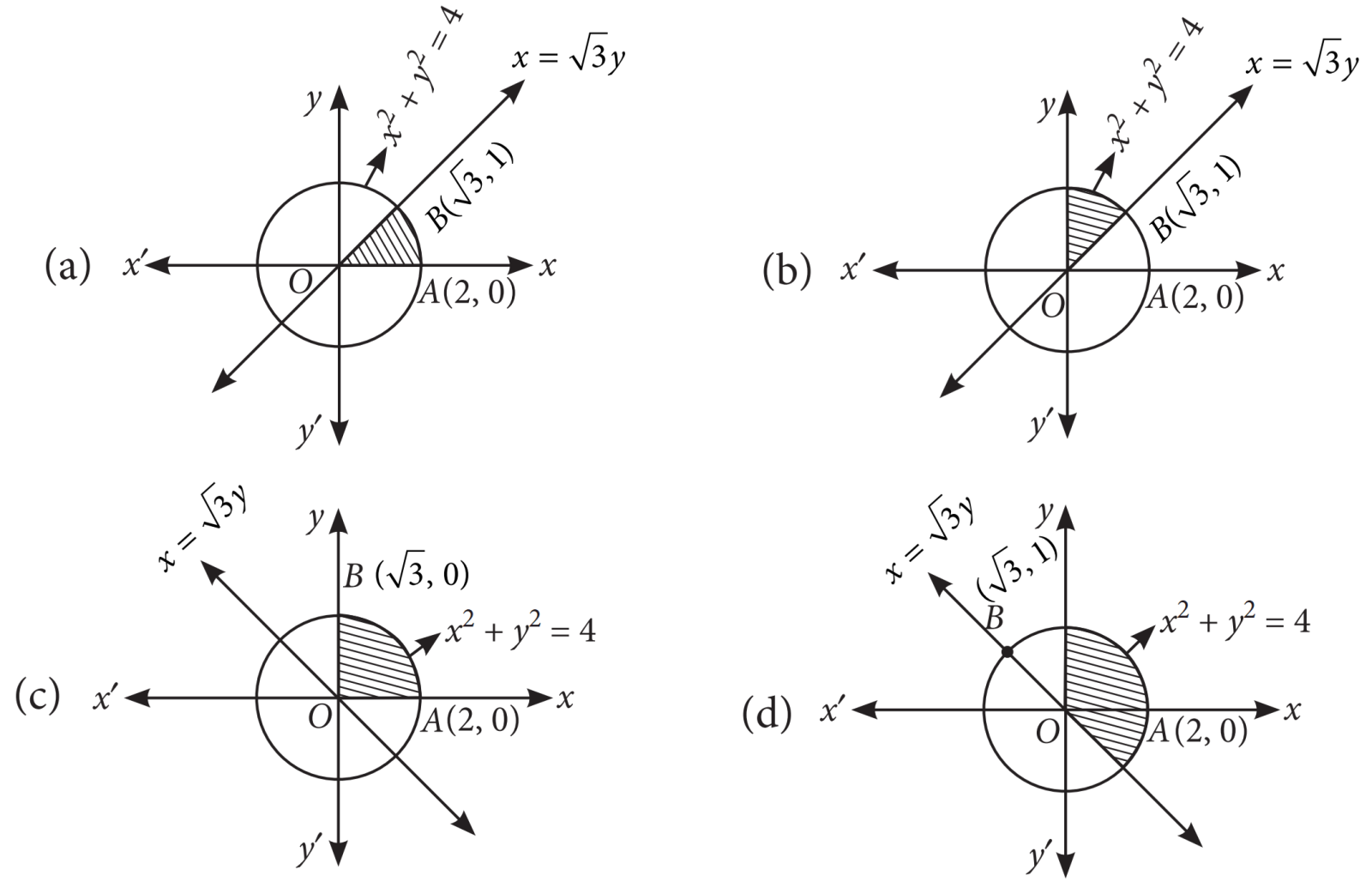
  1. Which of the following shaded portion represent the smaller area bounded by pizza and edge of knife in first quadrant?
  1. Value of area of the region bounded by circular pizza and edge of knife in first quadrant is.
  1. $\frac{\pi}{2}\text{ sq.units}$
  2. $\frac{\pi}{3}\text{ sq.units}$
  3. $\frac{\pi}{5}\text{ sq.units}$
  4. $\pi\text{ sq.units}$
  1. Area of each slice of pizza when child cut the pizza into $4$ equal pieces is.
  1. $\pi\text{ sq.units}$
  2. $\frac{\pi}{2}\text{ sq.units}$
  3. $3\pi\text{ sq.units}$
  4. $2\pi\text{ sq.units}$
  1. Area of whole pizza is.
  1. $3\pi\text{ sq.units}$
  2. $2\pi\text{ sq.units}$
  3. $5\pi\text{ sq.units}$
  4. $4\pi\text{ sq.units}$
Fill in the blank.
_________ matrix is both symmetric and skew symmetric matrix.
Fill in the blanks:
An example of a function which is continuous everywhere but fails to be differentiable exactly at two points is __________.
If $A =\left[\begin{array}{cc}\frac{1}{3} & 2 \\ 0 & 2 x-3\end{array}\right], B =\left[\begin{array}{cc}3 & 6 \\ 0 & -1\end{array}\right]$ and $AB = I$, then $x=$  __________ .
The order of the differential equation $x y \frac{d^2 y}{d x^2}+x\left(\frac{d y}{d x}\right)^2$ is ____________ .
If $A =\left[\begin{array}{ccc}-1 & 2 & 3 x \\ 2 y & 4 & -1 \\ 6 & 5 & 0\end{array}\right]$ has symmetric matrix, then value of $2 x+y$ is __________ .
Fill in the blanks.
If X follows binomial distribution with parameters n = 5, p and P (X = 2) = 9, P (X = 3), then p = _________.