MCQ
If $\ce{P, Q, R}$ are physical quantities, having different dimensions, which of following combinations can never be meaningful quantity?
  • $\Big(\frac{\text{P}-\text{Q}}{\text{R}}\Big)$
  • B
    $\text{PQ}-\text{R}$
  • C
    $\frac{\text{PQ}}{\text{R}}$
  • D
    $\frac{\text{PR}-\text{Q}^2}{\text{R}}$
Answer

Correct option: A.
$\Big(\frac{\text{P}-\text{Q}}{\text{R}}\Big)$

Need a full question paper?

Generate a complete, print-ready paper with questions like this in minutes — across 16+ boards, with answer keys.

Start Generating Free

Similar questions

Heat needed to convert $1$ kilogram ice at $0^o\,C$ to steam at $100^o\,C$ is
The substances having very short plastic region are
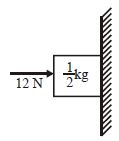
A horizontal force $12 \,N$ pushes a block weighing $1/2\, kg$ against a vertical wall.  The  coefficient of static friction between the wall and the block is $0.5$ and the coefficient of  kinetic friction is $0.35.$ Assuming that the block is not moving  initially. Which one of the following choices is correct (Take $g = 10 \,m/s^2$)
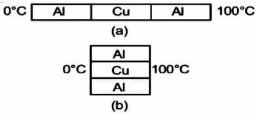
The three rods shown in figure have identical dimensions. Heat flows from the hot end at a rate of $40 \,W$ in the arrangement $(a)$. Find the rates of heat flow when the rods are joined as in arrangement $(b)$ is ......... $W$ (Assume $K_al=200 \,W / m ^{\circ} C$ and $\left.K_{c u}=400 \,W / m ^{\circ} C \right)$
A ball is dropped from the roof of a tower of height $h$. The total distance covered by it in the last second of its motion is equal to the distance covered by it in first three seconds. The value of $h$ in meter is  $(g = 10\,m/s^2)$
Two wheels are connected by a belt. The radius of larger wheel is three times that of the smaller one. What is the ratio of the rotational inertia of larger wheel to the smaller wheel, when both wheels have same angular momentum ?
Suppose all the surfaces in the previous problem are rough. The direction of friction on $B$ due to $A:$
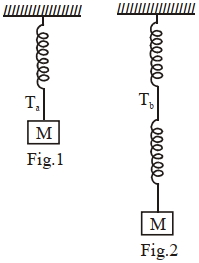
Consider two identical springs each of spring constant $k$ and negligible mass compared to the mass $M$ as shown. Fig. $1$ shows one of them and Fig. $2$ shows their series combination. The ratios of time period of oscillation of the two $SHM$ is $\frac{ T _{ b }}{ T _{ a }}=\sqrt{ x },$ where value of $x$ is

(Round off to the Nearest Integer)

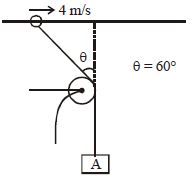
For the given fig. find the speed of block $A$ when $\theta  = {60^o}$
One mole of helium is adiabatically expanded from its initial state $({P_i},{V_i},{T_i})$ to its final state $({P_f},{V_f},{T_f})$. The decrease in the internal energy associated with this expansion is equal to