Question
If P, Q, R are physical quantities, having different dimensions, which of the following combinations can never be a meaningful quantity?

  1. $\frac{(\text{P}-\text{Q})}{\text{R}}$

  2. $\text{PQ}-\text{R}$

  3. $\frac{\text{PQ}}{\text{R}}$

  4. $\frac{(\text{PR}-\text{Q}^2)}{\text{R}}$

  5. $\frac{(\text{R}+\text{Q})}{\text{P}}$
Answer

  1. $\frac{(\text{P}-\text{Q})}{\text{R}}$
  1. $\frac{(\text{R}+\text{Q})}{\text{P}}$
Explanation:

In option (a) and (e) there is term (P - Q) and (R + Q) as different physical quantities can never be added or subtracted so option (a) and (e) can never be meaningful.

In option (b), the dimension of PQ may be equal to dimension of R so option (b) can be possible. Similarly dimensions of PR and Q2 may be equal and gives the possibility of option (d).

In option (c), there is no addition subtraction gives the possibilities of option (c).

Hence, verifies the right option (a) and (e).

Need a full question paper?

Generate a complete, print-ready paper with questions like this in minutes — across 16+ boards, with answer keys.

Start Generating Free

Similar questions

A solid sphere of volume V and density $\rho$ floats at the interface of two immiscible liquids of densities $\rho_1$ and $\rho_2$ respectively. If $\rho_1<\rho<\rho_2$, then the ratio of the volume of the parts of the sphere in upper and lower liquids is
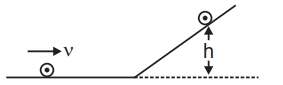
A disc of radius $R$ and mass $M$ is rolling horizontally without slipping with speed $v$. It then moves up an inclined smooth surface as shown in figure. The maximum height that the disc can go up the incline is:
A particle moves in the $x-y$ plane according to equation $\overrightarrow r  = (\widehat i + 2\widehat j)\, A \, \cos \omega t$. The  motion of the particle is 
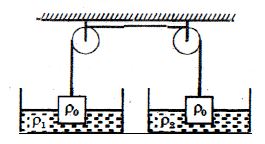
Consider two identical cylinders [each of mass $m$ density $\rho _0$ horizontal cross-section area $s$] in equilibrium, partially submerged in two containers filled with liquids of densities $\rho_1$ and $\rho_2$ as shown in figure. Find the period of small oscillations of this system about its equilibrium. Neglect the changes in the level of liquids in the containers. Neglect mass of the strings. acceleration due to gravity is $g$ . ($v$ is volume of each block)
Two masses $m_1$ and $m_2\, (m_1 < m_2)$ are released from rest from a finite distance. They start under their mutual gravitational attraction
Three particles $A, B$ and $C$ each of mass $m$ are lying at the corners of an equilateral triangle of side $L$. If the particle $A$ is released keeping the particles $B$ and $C$ fixed, the magnitude of instantaneous acceleration of $A$ is ........
An electric kettle (rated accurately at $2.5\, kW$) is used to heat $3\, kg$ of water from $15\,^oC$ to boiling point. It takes $9.5$ minute. Then, the amount of heat that has been lost is
A body, constrained to move in the $Y-$direction is subjected to a force given by $\overrightarrow F = ( - 2\hat i + 15\hat j + 6\hat k)\,N.$ What is the work done by this force in moving the body a distance $10\,  m$ along the $Y-$axis ...... $J$
Force $F$ applied on a body is written as $F =(\hat{ n } \cdot F ) \hat{ n }+ G$, where $\hat{ n }$ is a unit vector. The vector $G$ is equal to
A boat crosses a river with a velocity of $8\, km/h$. If the resulting velocity of boat is $10 \,km/h $ then the velocity of river water is...........$km/h$