Question
If $p(x) = 5 - 4x + 2x^2$, find:
$i. p(0)$
$ii. p(3)$
$iii. p(-2)$

Answer

$p(x) = 5 - 4x + 2x^2$
$\Rightarrow p(0) = (5 - 4 \times 0 + 2 \times 0^2)$
$= (5 - 0 + 0)$
$= 5$
$p(x) = 5 - 4x + 2x^2$
$p(3) = (5 - 4 \times 3 + 2 \times 3^2)$
$= (5 - 12 + 18)$
$= 11$
$p(x) = 5 - 4x + 2x^2$
$\Rightarrow p(-2) = [(5 - 4 \times (-2) + 2 \times (-2)^2]$
$= (5 + 8 + 8)$
$= 21$
 

Need a full question paper?

Generate a complete, print-ready paper with questions like this in minutes — across 16+ boards, with answer keys.
Start Generating Free

Similar questions

If $(x + y)^3 - (x - y)^3 - 6y(x^2 - y^2) = ky^2$, then $k =$
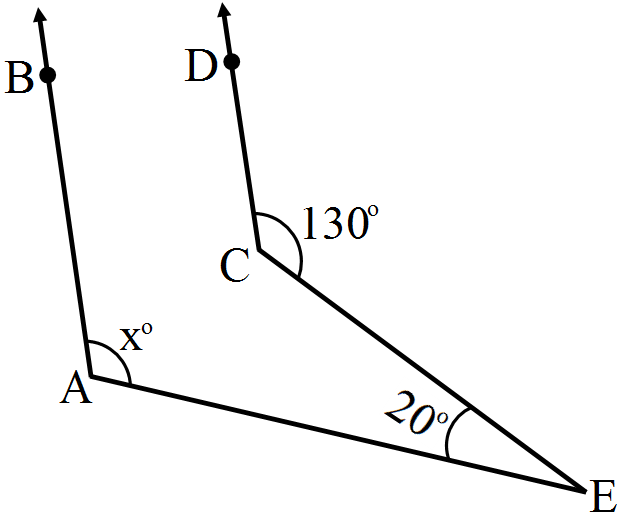
In the given figure, $AB\ ||\ CD$. Find the value of $x$.
The following data gives the amount of manure $($in thousand tonnes$)$ manufactured by a company during some years:
Year
$1992$
$1993$
$1994$
$1995$
$1996$
$1997$
Manure $($in thousand tonnes$)$
$15$
$35$
$45$
$30$
$40$
$20$
$i.$ Represent the above data with the help of a bar graph.
$ii.$ Indicate with the help of the bar graph the year in which the amount of manufactured by the company was maximum.
$iii.$ Choose the correct alternative:
The consecutive years during which there was the maximum decrease in manure production are:
$a. 1994$ and $1995$
$b. 1992$ and $1993$
$c. 1996$ and $1997$
$d. 199$5 and $1996$
If $x=2-\sqrt{3}$, find the value of $\left(x-\frac{1}{x}\right)^3$.
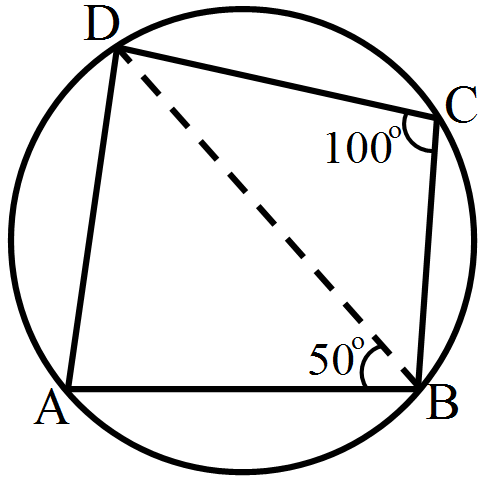
In the adjoining figure, $ABCD$ is a cyclic quadrilateral in which $\angle\text{BCD}=100^\circ$ and $\angle\text{ABD}=50^\circ.$ Find $\angle\text{ADB}.$
$A B C D$ is a rhombus and $P, Q, R$ and $S$ are the mid-points of the sides $A B, B C, C D$ and $D A$ respectively. Show that the quadrilateral $PQRS$ is a rectangle.
Simplify: $(a + b + c)^2 + (a - b + c)^2 + (a + b - c)^2$
In the given figure, $AB\ ||\ CD$. Find the value of $x$.
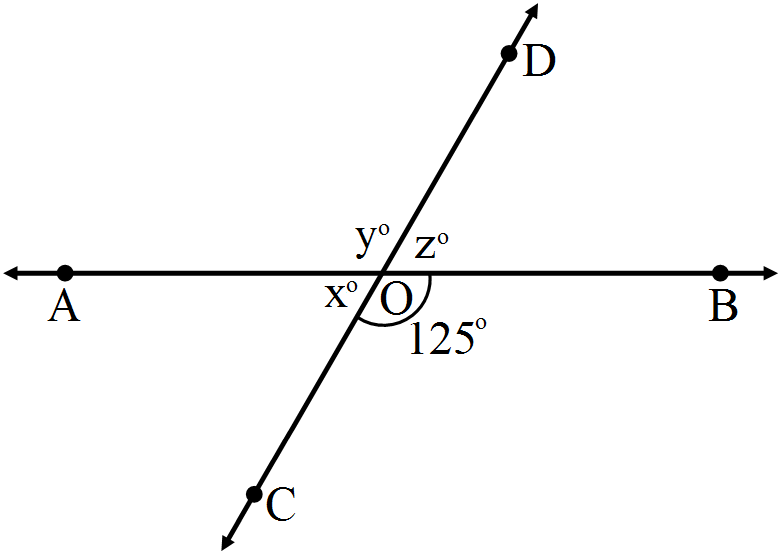
In the given figure, the two lines $AB$ and $CD$ intersect at a point $O$ such that $\angle\text{BOC}=125^\circ.$ Find the values of $x, y$ and $z.$