MCQ
If $R$ and $H$ represent the horizontal range and the maximum height achieved by a projectile then which of the relation exists?
  • A
    $\frac{H}{R} = 4\,\cot \,\theta $
  • $\frac{R}{H} = 4\,\cot \,\theta $
  • C
    $\frac{H}{R} = 4\,\tan \,\theta $
  • D
    $\frac{R}{H} = 4\,\tan \,\theta $

Answer

Correct option: B.
$\frac{R}{H} = 4\,\cot \,\theta $
b
$\begin{array}{l}
R = \frac{{{u^2}\sin 2\theta }}{g} = \frac{{2{u^2}\sin \theta .\cos \theta }}{g}\\
H = \frac{{{u^2}{{\sin }^2}\theta }}{{2g}}\\
\therefore \,\frac{H}{R} = \frac{{{u^2}{{\sin }^2}\theta }}{{2g}} \times \frac{g}{{2{u^2}\sin \theta .\cos \theta }}\\
\,\,\,\,\,\,\,\,\,\,\, = \frac{{\sin \theta }}{{4\cos \theta }}\\
 \Rightarrow \frac{R}{H} = \frac{{4\cos \theta }}{{\sin \theta }}\,or\,,\,\frac{R}{H} = 4\cos \theta 
\end{array}$

Need a full question paper?

Generate a complete, print-ready paper with questions like this in minutes — across 16+ boards, with answer keys.

Start Generating Free

Similar questions

If the radius and acceleration due to gravity both are doubled, escape velocity of earth will become ......... $km/s$
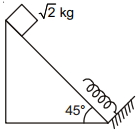
A block of mass $\sqrt{2}\,kg$ is released from the top of an inclined smooth surface as shown in figure. If spring constant of spring is $100\,N / m$ and block comes to rest after compressing the spring by $1 \,m$, then the distance travelled by block before it comes to rest is ......... $m$
A particle is moving with a constant speed $v$ in a circle. What is the magnitude of average velocity after half rotation
Which of the following is the incorrect graph for a sphere falling in a viscous liquid? (Given at $t = 0$, velocity $v = 0$ and displacement $x = 0$.) 
A balloon contains $1500 \,m^3$ of helium at $27^\circ C$ and $4$ atmospheric pressure. The value of helium at $ - \,3^\circ C$ temperature and $2$ atmospheric pressure will be ...... $m^3$
In producing a pure spectrum, the incident light is passed through a narrow slit placed in the focal plane of an achromatic lens because a narrow slit:
A body weight $W$, is projected vertically upwards from earth's surface to reach a height above the earth which is equal to nine times the radius of earth. The weight of the body at that height will be
$ABCDEF$ is a regular hexagon and forces represented in magnitude and direction by  $AB, AC,AD, AE$ and $AF$ act at $A$. Their resultant is :
A particle moves from position $3\hat i + 2\hat j - 6\hat k$ to $14\hat i + 13\hat j + 9\hat k$ due to a uniform force of $(4\hat i + \hat j + 3\hat k)\,N.$ If the displacement in meters then work done will be.........$J$
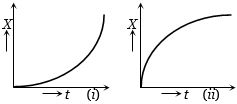
Figures $(i)$ and $(ii)$ below show the displacement-time graphs of two particles moving along the x-axis. We can say that