MCQ
If $R$ and $H$ represent the horizontal range and the maximum height achieved by a projectile then which of the relation exists?
  • A
    $\frac{H}{R} = 4\,\cot \,\theta $
  • $\frac{R}{H} = 4\,\cot \,\theta $
  • C
    $\frac{H}{R} = 4\,\tan \,\theta $
  • D
    $\frac{R}{H} = 4\,\tan \,\theta $

Answer

Correct option: B.
$\frac{R}{H} = 4\,\cot \,\theta $
b
$\begin{array}{l}
R = \frac{{{u^2}\sin 2\theta }}{g} = \frac{{2{u^2}\sin \theta .\cos \theta }}{g}\\
H = \frac{{{u^2}{{\sin }^2}\theta }}{{2g}}\\
\therefore \,\frac{H}{R} = \frac{{{u^2}{{\sin }^2}\theta }}{{2g}} \times \frac{g}{{2{u^2}\sin \theta .\cos \theta }}\\
\,\,\,\,\,\,\,\,\,\,\, = \frac{{\sin \theta }}{{4\cos \theta }}\\
 \Rightarrow \frac{R}{H} = \frac{{4\cos \theta }}{{\sin \theta }}\,or\,,\,\frac{R}{H} = 4\cos \theta 
\end{array}$

Need a full question paper?

Generate a complete, print-ready paper with questions like this in minutes — across 16+ boards, with answer keys.

Start Generating Free

Similar questions

A bar of mas $M=1.00 \mathrm{~kg}$ and length $L=0.20 \mathrm{~m}$ is lying on a horizontal frictionless surface. One end of the bar is pivoted at a point about which it is free to rotate. A small mass $m=0.10 \mathrm{~kg}$ is moving on the same horizontal surface with $5.00 \mathrm{~m} \mathrm{~s}^{-1}$ speed on a path perpendicular to the bar. It hits the bar at a distance $L / 2$ from the pivoted end and returns back on the same path with speed $v$. After this elastic collision, the bar rotates with an angular velocity $\omega$. Which of the following statement is correct?
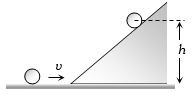
A disc of mass $M$ and radius $R$ rolls in a horizontal surface and then rolls up an inclined plane as shown in the fig. If the velocity of the disc is $v$, the height to which the disc will rise will be..
A weightless thread can bear a tension upto $3.7\,kg-wt$ . A stone of mass $500\,g$ is tied to it and revolved in a circular path of radius $4\,m$ in a vertical plane. If $g = 10\,ms^{-2}$, then the maximum angular velocity of the stone will be ......... $rad\,s^{-1}$
Two coherent sources of different intensities send waves which interfere. The ratio of maximum intensity to the minimum intensity is 25. The intensities of the sources are in the ratio:
A man in a balloon rising vertically with an acceleration of $4.9\,m/{\sec ^2}$ releases a ball $2$ sec after the balloon is let go from the ground. The greatest height above the ground reached by the ball is...........$m$ $(g = 9.8\,m/{\sec ^2})$
A projectile cover double range as compare to its maximum height attained. The angle of  projection is
The height at which the weight of the body become $\frac{1}{9}^{th}$. Its weight on the surface of earth (radius of earth $R$)
In isothermal process, the work done per gram molecule of gas is:
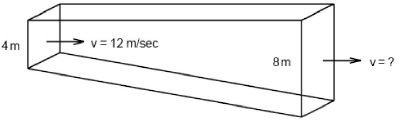
A river gradually deepens, from a depth of $4 \ m$ to a depth of $8\  m$ as shown. The width, $W$, of the river does not change. At the depth of $4 \ m$, the river's speed is $12\  m/sec.$ Its  elocity at the $8\  m$ depth is ......... $m/sec$
A uniform rope of length $L$ and mass $m_1$ hangs vertically from a rigid support. A block of mass $m_2$ is attached to the free end of the rope. A transverse pulse of wavelength $\lambda _1$, is produced at the lower end of the rope. The wave length of the pulse when it reaches the top of the rope is $\lambda _2$. The ratio $\lambda _2\,/\,\lambda _1$ is