MCQ
If relative decrease in vapour pressure is $0.4$ for a solution containing $1\, mol$ $NaCl$ in $3\, mol$ of $H_2O$, the degree of ionization of $NaCl$ is .......... $\%$.
  • A
    $60$
  • B
    $50$
  • $100$
  • D
    $40$

Answer

Correct option: C.
$100$
c
$\frac{{{{\text{P}}^o} - {{\text{P}}_{\text{S}}}}}{{{{\text{P}}^o}}} = \frac{{{\text{in}}}}{{{\text{in}} + {\text{N}}}}$

$0.4=\frac{i \times 1}{i \times 1+3}$

$0.4 \,\mathrm{i}+1.2= \mathrm{i}$

$0.6 \,\mathrm{i}=1.2$

$i=2$

$\mathop {{\text{NaCl}}({\text{aq}})}\limits_{1 - \,\alpha } \, \rightleftharpoons \mathop {{\text{N}}{{\text{a}}^ + }({\text{aq}})}\limits_\alpha   + \mathop {{\text{C}}{{\text{l}}^ - }({\text{aq}})}\limits_\alpha  $

$1+\alpha=2$

$\alpha=1$   or  $100\%$

Need a full question paper?

Generate a complete, print-ready paper with questions like this in minutes — across 16+ boards, with answer keys.

Start Generating Free

Similar questions

When a solute is present in trace quantities the following expression is used
Vapour pressure of solution of benzene $(P^o = 120\,torr)$ and toluene $(P^o = 80\, torr)$ having $2\,moles$ of each is ......... $torr.$
What will be the electromotive force of following cell at $298\,\, K$ ............. $\mathrm{V}$

$Pt\,|\,B{r_{2(\ell )0.1M}}\,|\,Br_{({\text{aq}}),0.1M}^ - \,||\,H_{_{({\text{aq}})0.1M}}^ + \,|\,{H_{2(g)1atm}}\,|\,Pt$ given ;  $E_{B{r^ - }/B{r_2}}^0\, = \, - 1.06\,V$

$\begin{array}{*{20}{c}}
  {C{H_3}\,\,\,\,\,\,\,} \\ 
  {|\,\,\,\,\,\,\,\,\,\,\,\,\,} \\ 
  {C{H_3} - CH - C \equiv CH} 
\end{array}\xrightarrow{{excess\,HBr}}$

The product of the above reaction is

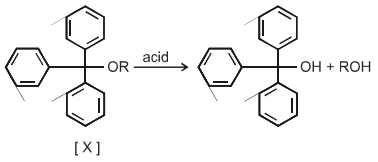
The acidic hydrolysis of ether $( X )$ shown below is fastest when :
For the dissociation reaction ${N_2}{O_4}\,(g)\,\, \rightleftharpoons \,2N{O_2}(g),$ the degree of dissociation  $(\alpha )$  in terms of $K_p$  and total equilibrium pressure $P$ is
A certain current liberated $ 0.504\,gm$ of hydrogen in $ 2$  hours. How many grams of copper can be liberated by the same current flowing for the same time in a copper sulphate solution ............ $\mathrm{gm}$
The incorrect stability order of $+3$ and $+1$ states of $13^{th}$ group elements (boron family) is
$\begin{matrix}
   O\,\,\,\,\,\,\,\,\,\,\,\,\,\,\,\,\,\,\,\,\,\,\,\,\,\,\,\,\,\,\,\,\,\,\,\,\,\,\,\,\,\,\,\,\,\,\,\,\,\,\,\,\,\,\,\,\,\,\,\,\,\,\,\,\,\,\,\,\,\,\,\,\,\,\,\,\,\,\,\,\,\,\,\,\,\,  \\
   ||\,\,\,\,\,\,\,\,\,\,\,\,\,\,\,\,\,\,\,\,\,\,\,\,\,\,\,\,\,\,\,\,\,\,\,\,\,\,\,\,\,\,\,\,\,\,\,\,\,\,\,\,\,\,\,\,\,\,\,\,\,\,\,\,\,\,\,\,\,\,\,\,\,\,\,\,\,\,\,\,\,\,\,\,\,\,\,  \\
   C{{H}_{3}}-C-O-C{{H}_{2}}-C{{H}_{3}}+H-{{\bullet }^{-}}\to (\bullet ={{O}^{18}})  \\
\end{matrix}$ One of the product of the reaction is
Product $(B)$ is