MCQ
If ${\rm{cosec }}A + \cot A = \frac{{11}}{2},$ then $\tan A = $
  • A
    $\frac{{21}}{{22}}$
  • B
    $\frac{{15}}{{16}}$
  • $\frac{{44}}{{117}}$
  • D
    $\frac{{117}}{{43}}$

Answer

Correct option: C.
$\frac{{44}}{{117}}$
c
(c) ${\rm{cosec}}\,A + \cot A = \frac{{11}}{2} $

$\Rightarrow {\rm{cosec}}\,A - \cot A = \frac{2}{{11}}$

Therefore $2\cot\, A = \frac{{117}}{{22}} $

$\Rightarrow \tan A = \frac{{44}}{{117}}$.

Need a full question paper?

Generate a complete, print-ready paper with questions like this in minutes — across 16+ boards, with answer keys.

Start Generating Free

Similar questions

A function $f$ satisfying $f ‘ \,(sin\, x)$ $= cos^2 x$ for all $x$ and $f(1) = 1$ is :
Let $z$ be a complex number such that $|z+2|=1$ and $\operatorname{lm}\left(\frac{z+1}{z+2}\right)=\frac{1}{5}$. Then the value of $|\operatorname{Re}(\overline{z+2})|$ is :
Let ${S_n} = 1 + q + {q^2} + ..... + {q^n}$ and ${T_n} = 1 + \left( {\frac{{q + 1}}{2}} \right) + {\left( {\frac{{q + 1}}{2}} \right)^2} + ...... + {\left( {\frac{{q + 1}}{2}} \right)^n}$ where $q$ is a real number and $q \ne 1$. If ${}^{101}{C_1} + {}^{101}{C_2}.{S_1} + ...... + {}^{101}{C_{101}}.{S_{100}} = \alpha\, {T_{100}}$ then $\alpha $ is equal to
The period of function

$f\left( x \right) = {\cos ^2}\left( {\sin x} \right) + {\sin ^2}\left( {\cos x} \right)$ is
Let $f(x) = \left\{ {\begin{array}{*{20}{c}}{|x|,\,0 < \,|x|\, \le 2}\\{\,\,1\,\,\,,\,\,x = 0\,\,\,\,\,\,\,\,\,}\end{array}} \right.$, then at $x = 0$ $f$ has
A pack of cards contains $4$ aces, $4$ kings, $4$ queens and $4$ jacks. Two cards are drawn at random. The probability that at least one of these is an ace, is
A box contains $100$ tickets numbered $1, 2 ...... 100$. Two tickets are chosen at random. It is given that the maximum number on the two chosen tickets is not more than $10$. The minimum number on them is $5$ with probability
Set of equations $a + b - 2c = 0,$ $2a - 3b + c = 0$ and $a - 5b + 4c = \alpha $ is consistent for $\alpha$ equal to
If the system of equation $3x - 2y + z = 0$, $\lambda x - 14y + 15z = 0$, $x + 2y + 3z = 0$ have a non-trivial solution, then $\lambda = $
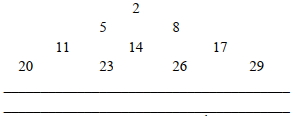
An arithmetic progression is written in the following way $Image$ The sum of all the terms of the $10^{\text {th }}$ row is..........